
Decision filter criteria are defined as specific, evaluative standards a business uses to accept, reject, or delegate choices without relying on gut instinct. When you create decision filter criteria for your business, you replace slow, inconsistent judgment calls with a repeatable system. Two proven frameworks anchor this process: weighted decision matrices and sequential delegation filters. Both give founders and business leaders a structured way to evaluate options against what actually matters, whether that is profit margin, strategic fit, or team capacity. The result is faster decisions, less second-guessing, and a team that knows when to escalate.
What are the essential components of business decision filters?
Decision filters fall into two main categories: scored criteria systems and sequential gate filters. Each serves a different purpose, and knowing which to use is the first real decision you will make.
Weighted decision matrices are the standard tool for comparing multiple options across several factors. The four components are criteria (the factors that matter), weights (how much each factor matters), scores (how well each option performs on each factor), and totals (the weighted sum that reveals the best option). A weighted matrix works best when you have two or more options and need to justify your choice to a team or investor.

Sequential delegation filters work differently. Rather than scoring options, they run a decision through a series of yes/no gates. A proven delegation framework applies five filters in order: irreversibility, unique knowledge required, authority level, identity and direction alignment, and development value for the team member. If a decision passes all five gates, it should be delegated with a defined owner, clear constraints, and an escalation trigger.
Binary gate filters are the simplest form. A decision either clears the gate or it does not. Failing any gate in the sequence results in a no, full stop. Binary filters are fast to apply and work well for client intake, vendor selection, or any repeating operational decision where speed matters more than nuance.
- Use weighted matrices for high-stakes, one-time decisions with multiple competing options.
- Use sequential gate filters for delegation and recurring operational choices.
- Use binary gates for fast, high-volume decisions with clear pass/fail criteria.
- Combine both types when a decision has both a hard dealbreaker and a scored preference layer.
Pro Tip: Build your gate filters before your weighted matrices. Gates eliminate bad options quickly, so you only run the heavier scoring process on options that have already cleared your non-negotiables.
How to set filter criteria: best practices for weighting and selection
The most common mistake founders make is building a filter with too many criteria. Limit your decision filter criteria to 4–8 factors for clarity and effectiveness. More than 10 criteria dilutes the importance of each one and makes the filter slow to use. That defeats the purpose.
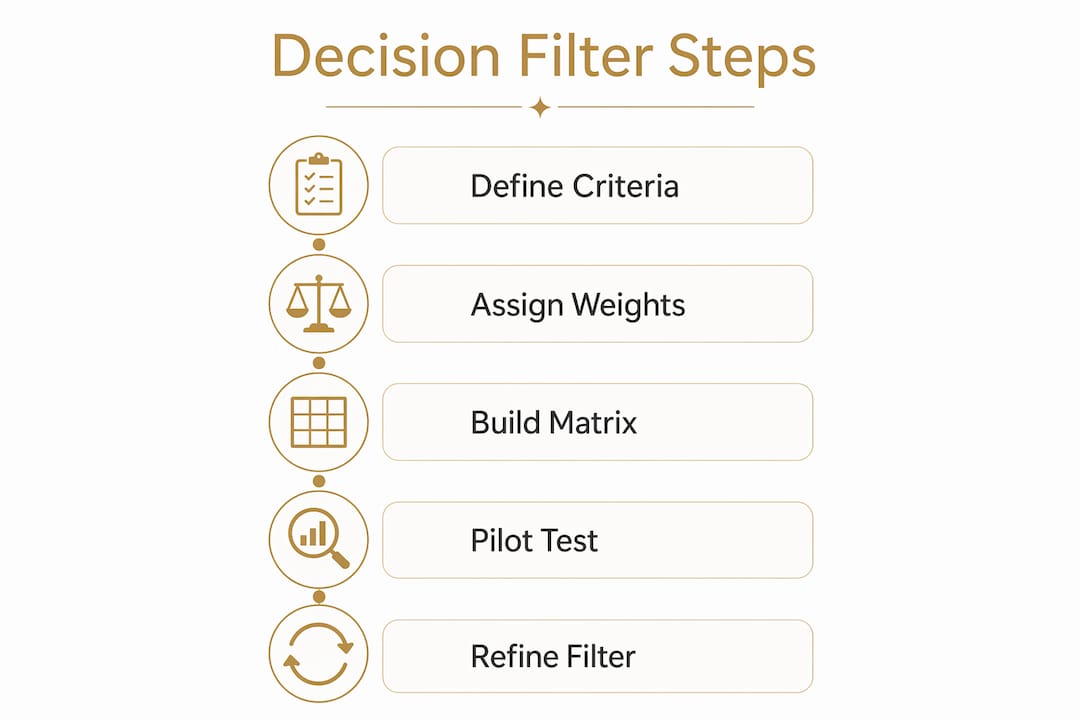
Once you have your criteria, assign each one a weight. The simplest method is direct allocation: distribute 100 points across all criteria based on relative importance. A criterion worth twice as much as another gets twice the points. The more rigorous method is pairwise comparison, where you compare each criterion against every other one and count how often it wins. Both methods produce a normalized weight that prevents any single factor from dominating unfairly.
Criteria selection process:
- List every factor that could influence the decision.
- Group overlapping factors and keep only the most distinct one from each group.
- Eliminate any factor you cannot score objectively in under two minutes.
- Rank the remaining factors by business impact.
- Keep the top 4–8 and assign weights using direct allocation or pairwise comparison.
- Confirm that no two criteria measure the same underlying variable.
Criteria independence matters more than most founders realize. If two criteria are measuring the same thing (for example, “revenue potential” and “market size” in a new product decision), you are double-counting that factor and skewing your results.
| Weighting method | Best for | Effort level |
|---|---|---|
| Direct allocation | Quick decisions, small teams | Low |
| Pairwise comparison | High-stakes decisions, multiple stakeholders | Medium |
| Ranked scoring (1–10 scale) | Ongoing operational filters | Low |
| Normalized percentage | Formal business cases, board review | Medium |
Pro Tip: Run a sensitivity analysis after you build your matrix. Change each criterion’s weight by 20% and see if the winning option changes. A decision that holds up across a wide range of weights is a reliable one. A decision that flips with a small weight change needs more discussion before you commit.
How to tailor decision filters to your business context
No two businesses share the same priorities, and a filter built for a $2M DTC brand will not serve a $20M one. The right filter reflects your current constraints, not a generic best practice.
Start by identifying your biggest decision bottlenecks. Where do choices pile up? Where does the team wait for you? Those are the decision types that need filters first. Significant business decisions require documented evidence, risk analysis, and stakeholder alignment. Day-to-day operational decisions benefit from lightweight processes that move fast without formal review.
Build your filters in layers:
- Dealbreakers first. Any criterion that is an absolute no regardless of other scores becomes a binary gate at the top of the filter. Examples: “Does this require more than 90 days of cash runway?” or “Does this conflict with our core brand positioning?”
- Weighted preferences second. Once a decision clears the dealbreaker gates, run it through the scored matrix for the factors that involve trade-offs.
- Context-specific filters third. A client intake filter looks nothing like a pricing decision filter. Build separate filters for each major decision category rather than one universal filter that tries to do everything.
Filters also need to evolve. Decision filter thresholds should rise as your capacity grows and shift as your priorities change. A filter you built when you were doing $500K in revenue will have different thresholds than one you need at $5M. Review your filters quarterly and adjust gate thresholds to match your current reality.
The growth vs. profitability trade-off is a good example of a context-specific filter. The criteria that matter when you are prioritizing growth (customer acquisition cost, payback period, channel scalability) are different from the criteria that matter when you are protecting margin (contribution margin per unit, fixed cost coverage, cash conversion cycle).
Step-by-step process to build and implement decision filters
Building a filter that actually gets used requires more than a spreadsheet. It requires a process your team trusts.
Step 1: Define your decision types. List the five to ten decisions that consume the most time or create the most friction. Group them into categories: strategic, operational, financial, and people decisions.
Step 2: Gather stakeholder input. Ask the people closest to each decision type what factors they already use informally. This surfaces hidden criteria and builds buy-in for the filter you are about to formalize.
Step 3: Select criteria and assign weights. Apply the best practices from the previous section. Keep criteria to 4–8, eliminate overlap, and use direct allocation or pairwise comparison to assign weights.
Step 4: Build your scoring system. Use a 1–10 scale for each criterion. Define what a score of 1, 5, and 10 looks like in concrete terms. Vague scoring scales produce inconsistent results. A business case evaluation framework that includes strategic alignment, financial return, risk, and feasibility gives you a ready-made starting point for financial decisions.
Step 5: Pilot with real decisions. Run three to five recent decisions through the filter and compare the filter’s output to the decision you actually made. If the filter consistently disagrees with your judgment, either your criteria are wrong or your weights are off.
| Implementation phase | Key action | Common mistake |
|---|---|---|
| Preparation | Define decision types and gather input | Skipping stakeholder input |
| Build | Select criteria, assign weights, define scoring | Too many criteria |
| Pilot | Test with past decisions, document rationale | Testing with hypothetical scenarios only |
| Refine | Adjust weights based on pilot results | Treating the first version as final |
| Monitor | Review filters quarterly, run sensitivity checks | Never updating thresholds |
Step 6: Document the rationale. Record why each criterion was chosen and how weights were assigned. This documentation protects the filter from being overridden by whoever has the loudest opinion in the room.
Step 7: Assign ownership using RACI. The RACI framework clarifies who is Responsible, Accountable, Consulted, and Informed for each decision type. Pairing RACI with your filter prevents the filter from becoming a tool only the founder uses. For founder decision frameworks that cover delegation in depth, the combination of RACI and sequential filters is particularly effective.
Common pitfalls when creating and using decision filter criteria
Most filter failures come from predictable mistakes. Knowing them in advance saves you from rebuilding your system from scratch six months later.
- Too many criteria. A filter with 15 criteria takes too long to apply and gets abandoned. Keep it to 4–8.
- Overlapping criteria. “Profit margin” and “revenue per unit” often measure the same thing in different units. Overlapping criteria inflate the weight of one underlying factor.
- Vague scoring definitions. If your team cannot agree on what a score of 7 means for “strategic fit,” the filter produces noise, not signal.
- Emotional override. Founders sometimes score options to justify a decision they have already made emotionally. The fix is to score criteria before you know which option wins, not after.
- No documentation. A filter with no written rationale gets reinterpreted every time someone new uses it. Document the “why” behind each criterion and weight.
- Never updating the filter. Filters must evolve as business priorities change. A filter that was right at launch may actively mislead you two years later.
Pro Tip: Set a calendar reminder every quarter to review your filters. Ask one question: “Has anything changed in our business that would shift the weight or threshold of any criterion?” If yes, update it before the next major decision cycle.
Key takeaways
Decision filter criteria work because they replace inconsistent judgment with a repeatable, documented system that your whole team can use.
| Point | Details |
|---|---|
| Limit criteria to 4–8 factors | More than 10 criteria dilutes importance and slows the filter down. |
| Use two filter types | Weighted matrices for scored trade-offs; sequential gates for delegation and pass/fail decisions. |
| Build in layers | Set dealbreaker gates first, then apply weighted scoring to options that clear them. |
| Test with real decisions | Pilot your filter against past choices to validate criteria and weights before full adoption. |
| Update filters quarterly | Thresholds must rise with capacity and shift with changing business priorities. |
Why most founders build filters too late
The uncomfortable truth is that most founders already have mental filters. They just have not written them down. The moment you write them down, two things happen. First, you can share them. Your team can make decisions without you. Second, you can test them. You can run sensitivity checks and see whether your criteria actually predict good outcomes or just confirm your biases.
Start with one decision type. Build one filter. Use it for 30 days. The clarity it produces will convince you faster than any framework ever could.
How Commerce Catalyst helps you build better decision systems
Knowing what criteria matter is only half the work. The harder part is knowing which financial and operational metrics your business should be filtering against right now.

Commerce Catalyst works directly with consumer brand founders to translate financial complexity into clear decision criteria. The DTC Financial Health Assessment identifies the specific constraints limiting your profitability and gives you the numbers you need to build filters that reflect your actual business, not a generic template. For supplement and wellness brands, the 2026 benchmarks for CAC, margins, and LTV provide the external reference points that make your filter thresholds meaningful. When you know what healthy looks like for your category, you can set criteria that protect it.
FAQ
What are decision filter criteria in business?
Decision filter criteria are specific, evaluative standards used to accept, reject, or delegate business choices in a consistent and repeatable way. They replace ad hoc judgment with a documented system that improves speed and reduces bias.
How many criteria should a decision filter have?
A decision filter should include 4–8 criteria for optimal clarity. More than 10 criteria dilutes the importance of each factor and makes the filter too slow to apply in practice.
What is the difference between a weighted matrix and a gate filter?
A weighted matrix scores multiple options across several criteria to find the best one. A gate filter runs a single decision through sequential yes/no questions and stops the moment one gate fails.
How often should I update my decision filter criteria?
Review your filters at least quarterly. Thresholds should rise as your business capacity grows and shift whenever your core priorities change.
Can decision filters be used for delegation?
Yes. A five-step delegation filter checks irreversibility, required knowledge, authority level, strategic alignment, and development value before assigning a decision to a team member.