
Mentorship is defined as ongoing guidance from an experienced advisor who helps founders think clearly, test assumptions, and make better strategic choices without relinquishing control. The role of mentorship in founder decisions goes far beyond advice. It creates a structured space where entrepreneurs slow down reactive thinking, pressure-test ideas, and build the judgment needed to lead through uncertainty. Programs like the MIT Venture Mentoring Service and university incubators across Spain and the U.S. have produced measurable evidence that mentorship directly improves decision quality and early startup success. For consumer brand founders navigating pricing, hiring, or capital allocation, that kind of guidance is not optional. It is the difference between reactive firefighting and deliberate strategy.
How does mentorship improve the founder decision-making process?
The role of mentorship in founder decisions is not to hand founders the right answer. It is to create the conditions where founders arrive at better answers themselves. A business mentor provides ongoing guidance and perspective that helps entrepreneurs make better decisions over time, which is fundamentally different from short-term consulting that delivers a recommendation and exits. That distinction matters because founders face decisions daily, not quarterly.
The core mechanism is assumption testing. Most bad founder decisions are not made from lack of information. They are made from unchallenged assumptions. A mentor forces you to articulate what you believe to be true, then asks why. That single habit, applied consistently, eliminates a significant category of strategic error. When you have to explain your logic out loud to someone with pattern recognition across dozens of companies, weak reasoning surfaces fast.

Mentorship also regulates the pace of decision-making. Founders under pressure default to speed. A mentor creates a natural checkpoint. Mentorship improves decision quality by slowing down major decisions and building clarity before commitment. That pause is not hesitation. It is the difference between a decision made from panic and one made from analysis.
Three specific ways mentorship improves the founder decision-making process:
- Sounding board function: Mentors absorb the emotional weight of a decision and reflect back the logic, separating urgency from importance.
- Accountability structure: Knowing you will report back to a mentor changes how you execute. Commitments made in mentoring conversations carry more weight than internal resolutions.
- Pattern interruption: Experienced mentors recognize the cognitive traps founders fall into repeatedly, including overconfidence in early traction and underestimating operational complexity.
Pro Tip: Before your next mentor meeting, write down the one decision you are avoiding. Bring that to the conversation first. Avoidance is almost always where the strongest thinking lives.
What mentorship models exist and how do they differ in impact?
Not all mentoring relationships produce the same results. The structure, duration, and composition of a mentoring arrangement shape how much it actually influences founder decisions. Understanding the differences helps founders choose the right model for their current stage.
| Model | Structure | Best for | Key limitation |
|---|---|---|---|
| One-on-one mentoring | Single mentor, ongoing relationship | Early-stage founders building foundational judgment | Limited perspective, single domain expertise |
| Team-based mentoring | Multiple mentors per founder, coordinated | Complex trade-offs across strategy, finance, and operations | Requires coordination, can create conflicting advice |
| Stage-specific mentoring | Mentor matched to venture phase | Founders at inflection points like launch or scaling | Relationship ends when stage ends |
| Accelerator mentoring | Cohort-based, structured program | Founders needing ecosystem access and peer learning | Variable mentor quality, short duration |
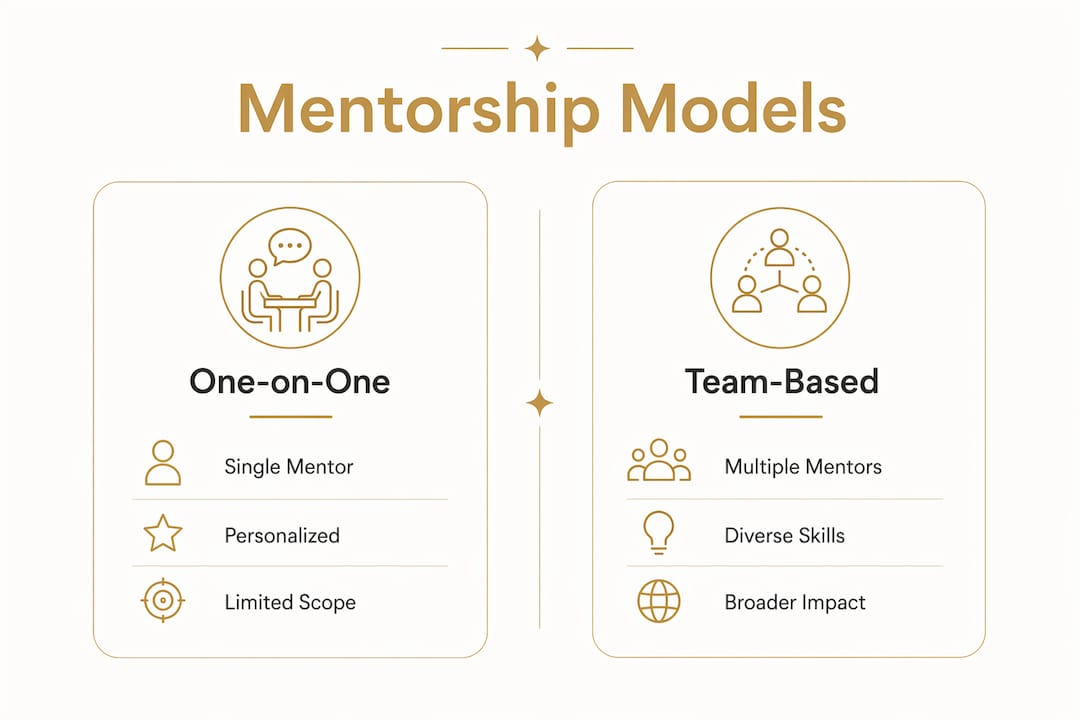
The MIT Venture Mentoring Service represents the most studied team-based model. MIT VMS supports over 5,100 mentees with more than 200 volunteer experts, providing strategic decision support and risk analysis without taking equity. That model works because it gives founders access to multidimensional expertise. A finance mentor, an operations mentor, and a market mentor sitting in the same conversation triangulate trade-offs that a single advisor would miss.
Research on Spanish accelerators and incubators covering 57 accelerators and 99 incubators confirms that mentoring type significantly affects ecosystem performance. Stage-specific mentoring, where the mentor’s focus aligns with the founder’s current decision horizon, outperforms generic mentoring in producing measurable outcomes. A mentor who excels at helping founders validate product-market fit is not necessarily the right person to guide a Series A fundraise.
Pro Tip: Map your current top three decisions to mentor expertise before selecting or continuing a mentoring relationship. If your mentor cannot speak credibly to at least two of those three, you need to expand your advisory circle.
What does research say about mentorship’s impact on startup success?
The evidence connecting mentorship to founder outcomes has moved well beyond anecdote. Recent studies provide statistically significant data on how mentoring programs affect decision quality, competency development, and early business results.
A study of 251 university incubator participants found that mentoring correlates with startup success at a significance level of p < 0.001, with measurable improvements in entrepreneurial competencies and early indicators like revenue and customer acquisition. That level of statistical confidence is unusually strong for behavioral research. It means the relationship between mentorship and founder performance is not noise. It is signal.
| Research source | Sample | Key finding |
|---|---|---|
| QCU university incubator study | 251 participants | Mentoring linked to improved decision-making and higher startup success rates (p < 0.001) |
| International Entrepreneurship and Management Journal | 57 accelerators, 99 incubators (Spain) | Mentoring type significantly affects ecosystem functioning and founder outcomes |
| MIT Venture Mentoring Service | 5,100+ mentees, 200+ mentors | Long-term team mentoring produces strategic clarity and risk reduction without equity cost |
The Spanish accelerator research published in the International Entrepreneurship and Management Journal adds an ecosystem dimension. Mentoring programs within accelerators affect not just individual founders but the broader functioning of the entrepreneurship ecosystem. That finding implies that the importance of mentorship in business extends beyond any single company. When mentoring quality rises across a startup community, the collective decision-making of that community improves.
The MIT VMS data reinforces the value of longevity. Short-term advisory relationships produce short-term clarity. Long-term mentoring builds the kind of judgment that compounds. Founders who engage with mentors across multiple stages develop a decision-making vocabulary that accelerates every subsequent choice.
How can founders actively use mentorship for better decisions?
Knowing that mentorship works is not enough. The founders who extract the most value from mentor relationships treat them as structured decision systems, not casual check-ins. The following framework turns mentoring conversations into a repeatable decision improvement process.
-
State your current assumption. Tell your mentor what you currently believe is true and why. This forces you to articulate your reasoning before it gets challenged, which surfaces gaps you did not know existed.
-
Request stress-testing, not validation. Explicitly ask your mentor to argue against your position. Most founders unconsciously seek confirmation. Reframe the ask so the mentor’s job is to find the holes, not approve the plan.
-
Set a specific next action. Every mentoring conversation should end with one concrete commitment. Not a to-do list. One decision or action you will take before the next meeting. Iterative decision loops that include clear action steps and review cycles produce measurably better outcomes over time.
-
Review outcomes at the next session. Close the loop. Report what happened when you executed the decision. This creates a feedback system that sharpens both your judgment and your mentor’s understanding of your business.
Stage-tailored mentoring outperforms generic mentoring precisely because it aligns the mentor’s expertise with the founder’s current decision horizon. A founder in validation mode needs a mentor who has navigated product-market fit. A founder preparing for an exit needs someone who has been through that process. Matching the relationship to the moment is not a nice-to-have. It is the primary driver of mentorship ROI.
Pro Tip: Review your last five major business decisions and identify which ones had mentor input. If fewer than three did, you are making high-stakes calls without the pattern recognition that mentorship provides. That is a structural gap worth closing immediately.
Key takeaways
Mentorship improves founder decision quality by creating structured accountability, assumption testing, and stage-matched expertise that no amount of solo analysis can replicate.
| Point | Details |
|---|---|
| Mentorship vs. consulting | Mentors provide ongoing guidance across decisions; consultants deliver one-time recommendations. |
| Team-based models outperform | MIT VMS and similar multi-mentor models triangulate complex trade-offs better than single advisors. |
| Research confirms the impact | A study of 251 incubator participants links mentoring to startup success at p < 0.001 significance. |
| Stage alignment is critical | Matching mentor expertise to your current decision horizon maximizes the quality of guidance received. |
| Structure the relationship | Iterative loops with defined decisions, stress-testing, and outcome reviews compound mentor value over time. |
Why most founders underuse their best resource
The other thing worth saying directly: mentor diversity matters. One mentor who thinks like you do is a comfort. Three mentors who approach problems from different angles is a decision-making advantage. If everyone in your advisory circle agrees with you, you have built an echo chamber, not a thinking system. The goal is productive friction, not reassurance.
Take your next decision further with Commerce Catalyst
The principles in this article reflect exactly how Commerce Catalyst works with consumer brand founders. Chris Wichert brings the kind of experienced, direct perspective that turns a stuck decision into a clear path forward. Whether you are navigating a profitability challenge, a scaling inflection point, or preparing for an exit, the Founder Hour is designed to give you focused, high-signal guidance in a single session. For founders who want a deeper look at their financial position before making major strategic moves, the DTC financial health assessment provides the clarity that good decisions require. If you are thinking about an exit, the exit advisory service integrates mentorship-level thinking with transaction expertise.
FAQ
What is the role of mentorship in founder decisions?
Mentorship provides founders with ongoing guidance, assumption testing, and accountability that improve decision quality over time. Unlike consulting, it functions as a continuous thinking partnership rather than a one-time recommendation.
How does mentorship differ from business consulting for founders?
A mentor offers perspective and helps founders think through decisions without prescribing fixed answers, while a consultant typically delivers a specific recommendation and exits. Mentors help founders test assumptions and build judgment that applies across future decisions.
What does research say about mentorship and startup success?
A study of 251 university incubator participants found that mentoring significantly improves entrepreneurial competencies and early startup success indicators including revenue and customer acquisition, with results significant at p < 0.001.
What is team-based mentoring and why does it matter?
Team-based mentoring assigns multiple mentors with different expertise to a single founder, allowing trade-offs across strategy, finance, and operations to be evaluated from multiple angles simultaneously. The MIT VMS model demonstrates this approach at scale with over 5,100 mentees.
How should founders choose the right mentor for their stage?
Founders should match mentor expertise to their current decision horizon, whether that is product validation, scaling, or exit planning. Stage-tailored mentoring consistently outperforms generic mentoring in producing measurable founder outcomes.