
If you’re weeks from a buyer conversation or an investor deck, here’s the short version: reconcile your P&L, balance sheet, and cash flow for the trailing three years, build a trailing-12 add-back schedule tied to your general ledger, pull customer revenue by account with churn and retention cohorts, tighten your inventory ledger and reserve policy, index your key contracts and flag any change-of-control clauses, confirm your IP ownership on paper, and document your supplier credits. That’s the core of a due diligence checklist brand owners need ready before anyone starts verifying instead of just asking questions.
In the next 48 to 72 hours, lock your month-end trial balance, export customer revenue by month and by account, and assemble your top ten contracts in one folder.
Pro Tip: The single strongest move is building a defendable add-back pack with owner-comp benchmarking attached. Buyers cut unsupported add-backs first, and every dollar they cut comes straight out of your valuation.
Key Takeaways
Sell-side readiness comes down to reconciled financials, a defensible add-back schedule, documented customer and supplier data, and a sequenced 8 to 12 week remediation window before buyer outreach begins.
| Point | Details |
|---|---|
| Start with financials | Reconcile 36 months of P&L, balance sheet, and cash flow before touching other categories. |
| Build the add-back pack | Tie every add-back to GL support; unsupported claims get cut hardest in QoE review. |
| Prove valuation resilience | Show pricing power, supplier diversification, and cohort retention, not just revenue growth. |
| Sequence the work | Run prep, fieldwork, remediation, and outreach across 8 to 12 weeks rather than compressing them. |
| Get a scoped diagnostic | Commerce Catalyst’s Financial Health Assessment targets the exact gaps that most often trigger re-trades. |
Table of Contents
- What Belongs on a Due Diligence Checklist for Brand Owners?
- What Does “Valuation Resilience” Actually Mean to a Buyer?
- How Do You Sequence an 8 to 12 Week Diligence Process?
- What Are the Most Common Due Diligence Red Flags?
- What This Checklist Gets Wrong in Most Advice Online
- How Commerce Catalyst Turns This Checklist Into a Plan
- Frequently Asked Questions
- Sources
What Belongs on a Due Diligence Checklist for Brand Owners?
A proper brand compliance checklist for a sale or raise runs across eight categories, and buyers move through them in a fairly predictable sequence. Financial and customer-concentration review comes first, followed by contracts, then operations, litigation and tax, and finally technology and compliance, according to CT Acquisitions. Preparing in that order, rather than alphabetically or by whatever’s easiest, saves weeks.
Financial records. Buyers want 36 months of monthly P&L, balance sheet, and cash flow, plus a trial balance and full reconciliations. The centerpiece is a quality-of-earnings style add-back schedule with source files attached, not just a spreadsheet of assertions. A DTC/CPG quality-of-earnings review typically finds that five line items drive roughly 80% of EBITDA adjustments: returns reserve, trade-deduction accruals, inventory standard-cost adjustments, owner add-backs, and overseas supplier credits. Have tax returns, AR/AP aging, and working-capital peg support ready alongside them.

Commercial data. Revenue by customer account, cohort retention curves, repeat-purchase rate, and channel mix tell buyers whether growth is durable or borrowed. If you sell through a major retailer, bring their chargeback and deduction calendar. Channel concentration is one of the fastest ways to compress a multiple, according to Iconic’s 2026 buyer guidance, so document how diversified your revenue actually is.
Legal and corporate records. This means formation documents, a clean cap table, shareholder agreements, and an indexed list of material contracts with change-of-control provisions flagged explicitly. Buyers also want IP assignments and trademark filings that prove the brand itself, not just the inventory, is unencumbered.
Supply chain and inventory. Supplier agreements, any tooling or prepayment documentation, landed-cost support, and evidence that your inventory standard costs were reset recently rather than inherited from three price cycles ago. Include an obsolescence schedule. Returns reserve is the single most commonly mismodeled line in this category; the standard buyer test walks trailing-12 return rates by SKU and channel against your booked reserve.
Operations and HR. An org chart, key-employee agreements, signed non-competes and invention assignments, and written SOPs for order-to-cash and fulfillment. Buyers are quietly testing founder dependency here as much as anything on the P&L.
Technology and data. Admin access lists, proof of domain and ad-account ownership, any cyber incident history, and source-code ownership documentation if custom development is part of the business.
| Category | What buyers test | Minimum acceptable evidence |
|---|---|---|
| Financial | Whether reported EBITDA holds up | Reconciled statements, GL-tied add-back schedule |
| Commercial | Revenue durability and concentration | Revenue by account, cohort retention, channel mix |
| Legal/Corporate | Clean ownership and contract risk | Cap table, indexed contracts, IP filings |
| Supply chain/Inventory | Reserve accuracy and cost basis | Supplier agreements, SKU-level return rate analysis |
| Operations/HR | Dependency on the founder | Org chart, SOPs, signed employment agreements |
| Technology | Access control and ownership | Admin lists, domain/ad-account proof |
Build your data room around this structure with a simple folder map: one top-level folder per category, subfolders by year or by contract, and a master index file naming exactly what’s inside each. A messy data room reads as a messy business even when the numbers are fine.
What Does “Valuation Resilience” Actually Mean to a Buyer?
Buyers in 2026 have shifted away from rewarding growth at any cost. They now pay up for valuation resilience: pricing power, diversified sourcing, and loyal repeat customers, rather than a brand built entirely on paid acquisition spend.
Each pillar has a metric attached. Pricing power shows up in gross margin stability across price changes. Diversified sourcing shows up in supplier concentration data. Repeat customers show up in cohort LTV against CAC over a 12 to 24 month window.
Three pieces of evidence prove this fastest: a price realization test showing margin held after a price increase, a cohort retention chart broken out by acquisition month, and signed confirmations from at least two suppliers per key SKU showing you’re not single-sourced.
Pro Tip: Two charts move buyer opinion faster than anything else in the deck: a cohort retention curve and a channel-level CAC trend line. Together they answer the question buyers actually care about, which is whether this business keeps working without the founder’s constant intervention.
How Do You Sequence an 8 to 12 Week Diligence Process?
Sell-side preparation run 8 to 12 weeks before you go to market tends to pay for itself. Sellers who commission a proper QoE and working-capital analysis ahead of time defend price 5 to 15% better and close 30 to 45 days faster than those who wait for a buyer to find the problems first.
| Weeks | Focus | Who leads |
|---|---|---|
| 0–2 | Assemble data pack, scope QoE | Founder + CFO/finance |
| 2–5 | QoE fieldwork, contract sweep | Outside QoE provider + legal |
| 5–7 | Remediation, deck alignment | Founder + finance |
| 7–12 | Buyer outreach and Q&A | Founder + advisory |
The founder’s job in weeks 0 to 2 is decisive, not administrative: choose the QoE provider and give finance a firm deadline for the trial balance. Legal’s real work starts in week 2, sweeping every material contract for consent-to-assign language before a buyer finds it first. Budget roughly $15,000 to $40,000 for accounting and QoE work, plus separate legal and tax review, depending on complexity. Compressing the timeline below eight weeks usually means skipping remediation entirely, which just moves the same problems into buyer Q&A where they cost more.
What Are the Most Common Due Diligence Red Flags?
Most deals don’t fall apart because the business is bad. They fall apart because the numbers don’t tie out, the story changes mid-process, or the seller can’t answer quickly. Here’s how to triage:
- Unreconciled books (Priority A). Reconcile 12 months of bank and card statements before a buyer asks. This is the fastest way to lose credibility in week one.
- Unsupported add-backs (Priority A). Build a folder tying every add-back to a GL entry and an invoice. Unsupported claims get cut 30 to 60% in typical QoE review.
- Customer concentration (Priority B). Disclose it early with a plan to diversify rather than let a buyer discover it in the revenue export.
- Undocumented supplier credits (Priority B). Produce the credit memos and reconcile them against COGS.
- Stale inventory standard costs (Priority B). Reset costing before diligence starts, not during it.
- Founder dependency (Priority C, disclose and mitigate). Show a management layer capable of running order-to-cash without you.
- Missing contract consents (Priority C). Flag any change-of-control clauses now so legal has time to secure waivers.
What This Checklist Gets Wrong in Most Advice Online
Most due diligence guides treat every category as equally urgent, which is bad advice for a founder with limited time before a term sheet. The evidence points somewhere more specific: financial credibility and customer concentration decide the deal in the first two weeks of buyer review, while categories like technology and HR mostly get tested for consistency, not surprises.
The bigger blind spot in conventional checklists is treating “growth” as the headline metric. Buyers in 2026 aren’t rewarding growth for its own sake anymore. They’re pricing durability, and a founder who shows up with a strong top line but no cohort retention data or supplier diversification looks riskier than one with slower, steadier numbers and clean documentation.
If you take one thing from this: don’t start with the data room folder structure. Start with the add-back schedule and the returns reserve calculation, because those two items generate more re-trades than everything else on this list combined. Fix the story your numbers tell before you worry about how the contract index is organized.
How Commerce Catalyst Turns This Checklist Into a Plan
Reading a checklist and executing one are different problems, especially while you’re still running the business. Commerce Catalyst’s DTC Financial Health Assessment is built specifically to close the financial gaps that create the most re-trades: unreconciled statements, unsupported add-backs, and inventory standard costs that don’t hold up under a QoE-style review.

A typical engagement produces a defendable add-back schedule tied to source documents, a working-capital peg analysis, and a prioritized remediation plan that tells you exactly which fixes to make before buyer fieldwork starts. Founders who run this diagnostic before going to market shrink the number of surprises buyers find later, which is where most price cuts happen. If pricing power and repeat-purchase behavior are unclear in your own numbers, the DTC Operator Diagnostic is the faster starting point. Either way, the next step is the same: book an assessment now, while you still have 8 to 12 weeks of runway to fix what a buyer would otherwise find for you.
Frequently Asked Questions
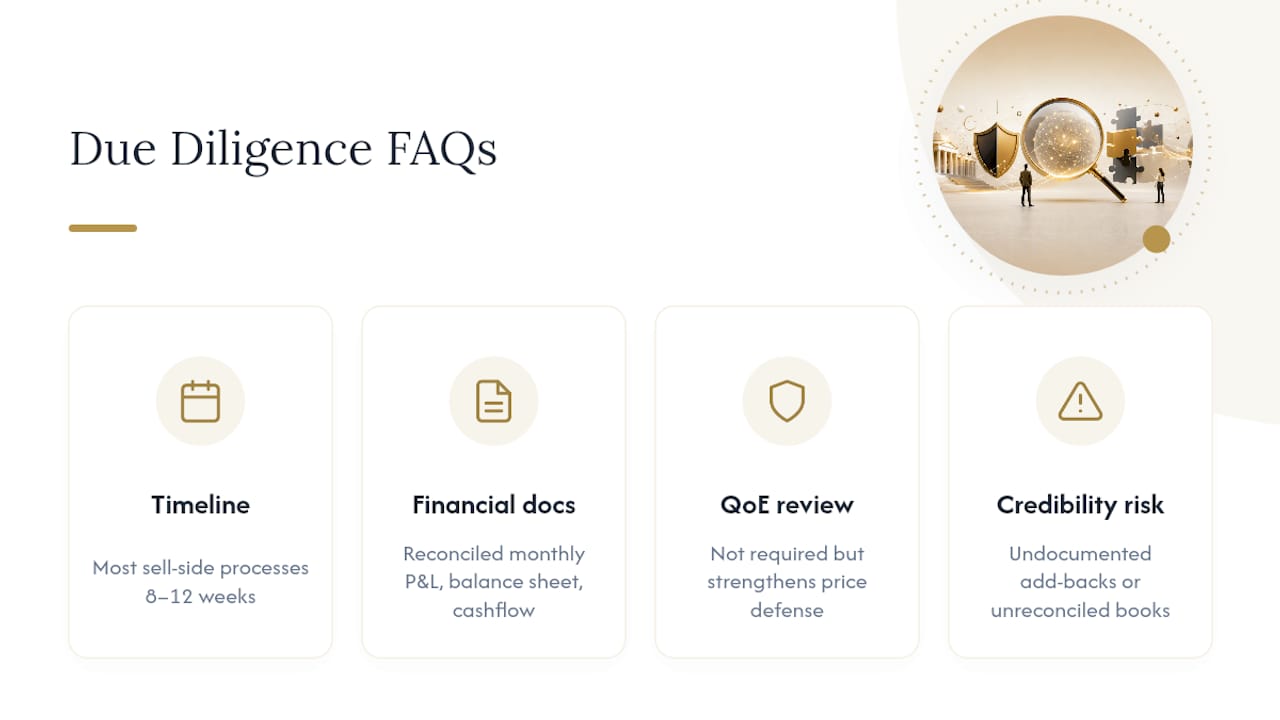
How long does a full due diligence review usually take for a $5M to $75M brand? Most sell-side processes run 8 to 12 weeks from data pack assembly through buyer Q&A, though compressed timelines are possible if the books are already reconciled.
What’s the difference between a due diligence checklist and a data room? The checklist tells you what to gather; the data room is where you organize and present it. A clean checklist with a disorganized data room still slows buyers down.
Which financial documents do buyers ask for first? Reconciled monthly P&L, balance sheet, and cash flow statements, along with a trial balance and an add-back schedule tied to general ledger support.
What’s the fastest way to lose credibility during due diligence? Presenting add-backs without documentation, or having books that don’t reconcile month to month, both signal to buyers that the numbers can’t be trusted.
This article is general information, not a substitute for advice from a qualified financial advisor. Consult a qualified financial professional about your own circumstances before acting on anything here.
Sources
- Consumer M-and-A Due Diligence: Where deals are won and lost: IMAP
- Sell-Side Due Diligence (2026): What Buyers Dig Into First | CT Acquisitions
- Top Due Diligence Pitfalls When Selling a Business: Waddell Mergers & Acquisitions