Proactive, cross-functional cost transformation, centered on product design, landed cost, procurement, promo governance, and pricing, delivers durable savings without eroding brand value. Cost reduction strategies for product brands that work share one trait: they treat cost as a system, not a spreadsheet line to slash under pressure.
The evidence backs the integrated approach over piecemeal cuts. Addressing the four common COGS leaks together has produced an average COGS reduction of 22.6% across more than 1,500 projects, and a governed 12-week takeout sprint can push EBITDA up 10-15% in six months.
Your first move this month:
- Pull 12 months of purchase orders, bills of materials, and promo accruals for your top five SKUs.
- Rank suspected leaks by dollar size, not by how annoying they are.
- Pick the single largest leak and run a two-week diagnostic before touching anything else.
Quick Stat: A combined attack on markup, material waste, defects, and freight/packaging bloat has averaged a 22.6% COGS reduction and roughly 25% higher net profit on improved SKUs.
Key Takeaways
Sustainable cost reduction works because it combines product, supply chain, promo governance, and pricing into one governed program with guardrails, rather than isolated cuts.
| Point | Details |
|---|---|
| Address leaks together | Attacking markup, material waste, defects, and freight bloat as one program averages a 22.6% COGS reduction. |
| Set guardrails before cutting | Track OEE, yield rate, and OTIF weekly so savings don’t quietly erode throughput or quality. |
| Validate before scaling | Test material or feature changes on small samples with a defined rollback trigger before full rollout. |
| Govern trade spend monthly | Reconcile promo accruals and apply an ROI gate to stop the 2 to 5% revenue leak common in retail deductions. |
| Start with a focused diagnostic | Commerce Catalyst’s DTC Financial Health Assessment identifies your biggest leak before you commit to a full sprint. |
Table of Contents
- Why Reactive Cost Cuts Fail Product Brands
- Test Changes Before You Lock Them In
- Design and Manufacturing Levers That Cut Cost Without Cutting Quality
- Packaging and Landed Cost: The Hidden Recurring Expense
- Procurement Levers: Should-Cost Modeling and Vendor Sprints
- Commercial Levers: Trade Spend, SKU Rationalization, and Pricing
- The First 90 Days: Audit, Pilot, Lock In
- The Traps That Quietly Erase Your Savings
- How Commerce Catalyst Operationalizes This Playbook
- Long-Term Savings vs. Quick Wins: What Actually Sustains Margin
- Why Cost Programs Fail Without Cross-Functional Buy-In
- Getting Your Team to Actually Adopt the New Process
- Beyond Procurement: Logistics and Inventory as Cost Levers
- The Founder-Side Perspective: Prioritization Beats Ambition
- Run Your Cost Sprint With Commerce Catalyst
- Sources
Why Reactive Cost Cuts Fail Product Brands
Reactive cost cutting shows up after a margin miss: an emergency memo, a freeze on discretionary spend, a demand to “find 5% somewhere.” Proactive cost reduction strategies for product brands work the opposite way. They start with a hypothesis about where money leaks, test it, and build in guardrails before anyone touches a supplier contract or formula.
The difference in outcomes is not subtle. Oliver Wyman’s research on consumer goods cost management found that programs without cross-functional leadership and clear governance routinely miss their savings targets, often because finance, ops, and brand teams pull in different directions once pressure mounts. Reactive cuts also tend to hit the same three places: headcount, maintenance, and marketing, none of which fix the actual cost structure.
Whichever program you run, track these weekly:
- OEE (overall equipment effectiveness), so cuts don’t quietly choke throughput.
- Yield rate, to catch material substitutions that increase scrap.
- OTIF (on-time, in-full), because a cheaper input that misses shipping windows isn’t actually cheaper.
Test Changes Before You Lock Them In
Cutting an ingredient or feature without checking whether customers notice is how brands quietly destroy the thing they built. The safer path runs through small-sample validation before any change touches the full production line.
- Run in-home usage tests. A panel of 40 to 80 customers using the modified product for two to three weeks reveals whether a substitution changes perceived quality.
- Build a value map. Score every ingredient, feature, and packaging element against its actual contribution to willingness to pay, not its cost alone.
- Set a hypothesis, then a rollback trigger. Define in advance what preference-test score or complaint rate kills the change.
- Roll out in phases. Test regionally or through one retailer before a full SKU conversion.
Pro Tip: Run the preference test blind, without brand packaging, so you’re measuring the product change itself and not loyalty bias skewing the result.
Design and Manufacturing Levers That Cut Cost Without Cutting Quality
The biggest, most durable savings come from decisions made before a product ever reaches the factory floor. Design for Manufacturing, or DFM, means engineers evaluate cost, part count, and assembly complexity while a product is still on the drawing board rather than after tooling is cut. Retroactive cost reduction on a locked design is expensive and slow; DFM applied early avoids that trap entirely.

Roland Berger’s VISION framework makes the case in concrete terms: aligning engineering, procurement, and supplier co-development from the start has unlocked direct-material savings as high as 35% in some engagements, largely because teams change how a part is made rather than just asking for a percentage discount on the existing design.
Material substitution is the second lever, and it’s the one that breaks brands most often when rushed. A resin swap, a lower gauge on a metal component, or a cheaper adhesive can save real money, but only with a documented acceptance criteria: defined tolerance ranges, a minimum sample size for durability testing, and sign-off from both engineering and quality before scaling. Standardizing components across SKUs, using one fastener type across three products instead of five, compounds savings through purchasing volume without touching the customer experience at all.
Inline quality control is the guardrail that makes all of this safe. A Golden Sample, the physical reference unit every production run gets checked against, prevents the slow drift where small tolerances stack up until a product feels different without anyone approving that change. Brands that pair DFM, factory-direct sourcing, and disciplined inline QC see more durable reductions than those relying on one-off procurement discounts, because the savings are engineered into the product rather than negotiated after the fact.
- DFM review happens before tooling, not after.
- Every material substitution needs a written acceptance test, not a verbal “looks fine.”
- Golden Samples get checked at defined production intervals, not just at launch.
Packaging and Landed Cost: The Hidden Recurring Expense
Packaging cost hides in places most teams never audit: dimensional weight fees on ecommerce shipments, inefficient master pack configurations that waste pallet space, and fulfillment surcharges tied to box dimensions rather than product weight. These recur on every unit shipped, which makes even small fixes compound fast.
Start the audit here, not with the primary package:
- Measure actual carton cube utilization against your 3PL’s dimensional weight formula.
- Check master pack counts against pallet and truck capacity, unused space is money paid to ship air.
- Confirm HTS classification and freight routing haven’t drifted since your last customs review.
Primary package changes, the bottle, box, or pouch the customer actually sees, deserve more caution because they touch perceived value directly. Reserve those for cases where consumer testing confirms no drop in perceived quality. Carton-level and master-pack changes carry far less brand risk and often deliver comparable savings. Run landed-cost checks quarterly, not annually; freight lanes, tariff classifications, and fuel surcharges shift often enough that a savings win from eighteen months ago can quietly reverse itself.
Procurement Levers: Should-Cost Modeling and Vendor Sprints
Procurement savings that last come from understanding what a part should cost to make, not from asking a supplier for a percentage off. Here’s the sequence that works:
- Rank your top 10 vendors by spend and run a focused four-to-six-week renegotiation sprint rather than a slow, year-round cycle.
- Build a should-cost model by walking the bill of materials and estimating factory labor, machine time, and yield rate rather than accepting the quote at face value, Roland Berger’s approach to this data-driven negotiation consistently outperforms percentage-target asks.
- Set realistic targets per vendor tier. Commodity inputs might yield 3-5%, custom-tooled components far less without a design change.
- Decide on co-packers deliberately. Consolidate volume with fewer, stronger partners, renegotiate terms with existing ones, or insource only when volume justifies the capital.
Should-cost modeling works because it gives you a number to negotiate against, not a hope.
Commercial Levers: Trade Spend, SKU Rationalization, and Pricing
Trade spend is where margin disappears quietly. Co-op advertising funds, off-invoice deductions, and slotting allowances commonly leak 2 to 5% of revenue when accruals aren’t reconciled against actual retailer performance. The fix is procedural: monthly accrual reconciliation and a promotion ROI gate that kills underperforming deals before they renew automatically.
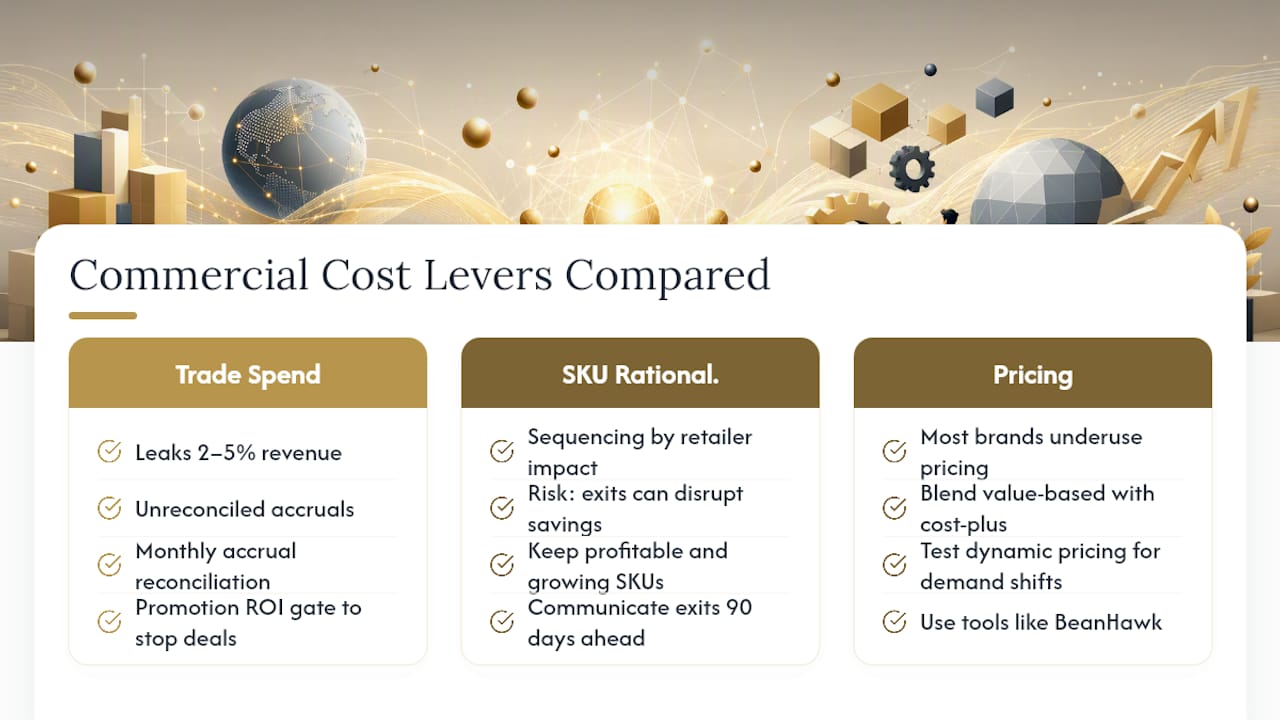
SKU rationalization is the second lever, and sequencing matters more than the decision itself. Apply simple rules, keep what’s profitable and growing, fix what’s fixable through reformulation or repricing, migrate slow SKUs into a simpler pack, and exit the rest, but sequence exits by retailer impact and communicate 90 days ahead to avoid disruption that erases the savings you just captured.
Pricing is the lever most brands underuse. Shopify’s enterprise pricing guidance recommends blending value-based pricing for differentiated SKUs with cost-plus as a floor for predictable ones, and testing dynamic pricing where demand fluctuates. Tools like BeanHawk can help brands see true channel-level cost before deciding where a price test makes sense.
Pro Tip: Never launch a price increase and a cost cut in the same promotional cycle, you won’t know which move drove the margin change or the volume response.
The First 90 Days: Audit, Pilot, Lock In
Run this in three phases rather than trying to fix everything at once.
- Weeks 1-3: Audit. Pull POs, BOMs, supplier terms, and promo accrual records for your top 10 SKUs by revenue.
- Weeks 4-8: Pilot. Test the two or three highest-confidence levers on a limited SKU set or region.
- Weeks 9-12: Lock in. Roll validated changes company-wide and set kill/continue thresholds for anything still uncertain.
The Traps That Quietly Erase Your Savings
The biggest risk isn’t picking the wrong lever, it’s letting a real saving unravel because nobody watched the second-order effect. Deferred maintenance and thin-staffed lines often look like savings for a quarter, then OEE and yield start sliding as scrap rates climb. Material swaps made without a validated preference test are the second trap: the unit cost drops on the invoice, and three months later returns or complaints eat the gain twice over.
Set floors before you start, not after something breaks: a minimum OEE threshold, a yield floor tied to your historical average, and an OTIF target you won’t dip below. Review them weekly. A program that hits its cost target while missing every guardrail hasn’t actually saved anything.
How Commerce Catalyst Operationalizes This Playbook
Commerce Catalyst built its service model around exactly this sequence, moving founders from diagnosis to disciplined execution rather than leaving them with a report and no follow-through.
- The DTC Financial Health Assessment maps directly to the audit phase, surfacing where COGS, trade spend, and overhead are leaking.
- Fractional COO engagements support the pilot and lock-in phases, translating the plan into execution across procurement, ops, and finance.
- Related reading on separating fixed and variable brand costs helps teams model the should-cost work covered above.
Founders rarely lack ideas for where to cut. What they lack is a disciplined way to prioritize which cut actually moves the P&L without breaking the brand.
Long-Term Savings vs. Quick Wins: What Actually Sustains Margin
Short-term cost cuts and long-term cost transformation solve different problems, and confusing them is how brands end up right back where they started within a year. A short-term win, a one-time vendor discount, a temporary freeze on discretionary spend, buys breathing room. It rarely changes the underlying cost structure of the product.
Long-term sustainability requires the harder work: DFM decisions baked into the next product generation, should-cost models that inform every future sourcing decision, and pricing architecture that reflects real value rather than reactive discounting. These take longer to show results, often a full product cycle or fiscal year, but they compound. A 3% material saving locked in through design persists across every unit made afterward. A one-time vendor discount expires the moment the contract renews.
The trade-off brand leaders actually face isn’t “cheap now versus expensive later.” It’s “fast and fragile versus slower and durable.” A brand under real cash pressure may need the short-term lever regardless, and that’s a legitimate call. The mistake is treating a short-term fix as if it were the strategy rather than a bridge to the structural work. Track both on separate ledgers: savings that expire on a renewal date, and savings that are now permanently part of your unit economics. If your finance team can’t tell you which bucket a given saving belongs to, you don’t yet have a program. You have a series of good quarters that might not repeat.
Why Cost Programs Fail Without Cross-Functional Buy-In
Cost reduction that touches only finance or only procurement rarely survives contact with the rest of the organization. A sourcing team can renegotiate a vendor contract, but if operations wasn’t consulted, the new material might not run cleanly on existing equipment. A pricing change decided in a boardroom without input from sales can trigger channel conflict that erases the margin gain in lost volume.
The brands that make savings stick build a small standing team with representation from finance, operations, procurement, and brand or marketing, meeting on a fixed cadence, weekly during an active sprint, monthly once changes are locked in. This isn’t bureaucracy for its own sake. It’s the mechanism that catches a material substitution before it reaches a customer’s hands, or flags that a “cost saving” packaging change actually increases damage claims because nobody on the ops side reviewed it.
Brand and product teams deserve a permanent seat at this table, not a courtesy invite. Every lever discussed so far, DFM, material substitution, SKU exits, pricing, carries brand-perception risk that finance and procurement alone can’t evaluate. The operational streamlining that supports these programs works best when it’s designed jointly rather than imposed top-down.
Set a shared scorecard everyone sees, the same OEE, yield, and OTIF numbers referenced earlier, so no function can claim a win that another function’s data contradicts. Disagreement is healthy here; silence usually means someone wasn’t in the room who should have been.
Getting Your Team to Actually Adopt the New Process
The best should-cost model or DFM checklist is worthless if the people running the line, negotiating with vendors, or approving promotions don’t use it. Change management for cost reduction initiatives fails most often not because the plan was wrong, but because nobody explained why the change was happening or what happens to the people whose job it touches.
Start with transparency about the guardrails, not just the targets. Employees who hear “we need to cut 8%” without hearing “and we will not let OEE drop below our floor to get there” reasonably assume the cut will come at their expense, through longer shifts, thinner staffing, or quality shortcuts nobody wants to own. State the guardrails out loud, repeatedly, and employees start trusting the program enough to flag problems early rather than hiding them.
Give frontline teams a real channel to surface friction. Line operators often know exactly which “harmless” material swap will cause a jam three weeks before a defect report proves it. A quick weekly check-in during the pilot phase, five minutes, not a formal meeting, catches more real problems than a quarterly survey ever will.
Recognize the wins publicly and specifically. A finance-only savings announcement means little to the person who spotted the fix. Naming the team or shift that identified a validated improvement does more for adoption of the next initiative than any incentive program, because it signals the company notices operational insight, not just operational compliance.
Beyond Procurement: Logistics and Inventory as Cost Levers
Procurement gets the attention, but logistics and inventory management often hide comparable savings that go unaudited for years. Inventory carrying cost, warehousing, insurance, obsolescence risk, and capital tied up in stock, quietly erodes margin on every SKU sitting longer than it should. A demand-planning process that’s slightly too conservative results in safety stock that ties up cash without ever showing up as a “cost” on a P&L line item anyone reviews.

Freight is the more visible lever. Consolidating shipments, renegotiating carrier contracts against actual volume rather than last year’s rates, and reviewing routing decisions after a network changes (a new co-packer, a new distribution center) all recover cost without touching the product at all. Many brands set freight terms once at launch and never revisit them as volume scales, which means a rate negotiated for a 10,000 unit run is still in effect at 100,000 units.
Inventory turns and days of supply deserve the same governance rigor as OEE and yield. Set a target range for inventory turns by SKU velocity tier, fast movers and slow movers shouldn’t carry the same safety stock logic, and review it in the same cadence as your other guardrail metrics. A brand that fixes its COGS but lets inventory carrying costs balloon has moved the leak, not closed it.
The Founder-Side Perspective: Prioritization Beats Ambition
Chris Wichert has spent years inside founder-side financial diagnostics, and the pattern repeats: brands don’t fail from lacking ideas, they fail from tackling five cost levers at once. Pick the audit’s biggest leak, fix it fully, then move to the next. Start there.
Run Your Cost Sprint With Commerce Catalyst
Most brands know they’re leaking margin somewhere. What they lack is the diagnostic discipline to find the biggest leak fast, and the operational bandwidth to fix it without breaking throughput or brand trust while running the rest of the business. Commerce Catalyst closes that gap directly: instead of a generic consulting engagement, you get a founder-led process built specifically for consumer brands with real P&L pressure.
The DTC Financial Health Assessment matches the audit phase covered above, pulling apart your COGS, trade spend, and overhead to show exactly where the leak sits and how big it actually is. From there, a Fractional COO engagement carries the plan through the pilot and lock-in phases, so the changes stick instead of quietly reversing after month four. If your goal extends further, toward a future sale, the groundwork this process builds feeds directly into stronger financials for that conversation too.
Start with the assessment. It’s the fastest way to know which of the levers in this article actually matters for your P&L right now.
Sources
- The Four Places Consumer Brand COGS Actually Leaks (and What Closes Each One) - Linton Group
- CPG Cost Takeout: 12-Week Sprint Playbook | A Faster Exit
- VISION Framework: Reimaging product cost improvement | Roland Berger