Start here, within the next 72 hours:
- Update your billing descriptor to match your customer-facing brand name or URL, not your legal entity name. This single change frequently cuts “unrecognized charge” disputes significantly.
- Audit your order confirmation and shipping emails: add tracking links, estimated delivery windows, and a direct customer service contact so buyers never feel they need to call their bank.
- Enable AVS and CVV checks on every card-present and card-not-present transaction, and flag orders that fail both as high-risk for manual review.
These three steps target friendly fraud and merchant error, which together account for the majority of disputes most merchants face. Criminal fraud matters too, but it rarely dominates a dispute mix until volume and product risk climb. Fix the communication failures first.
Key Takeaways
Effective chargeback reduction requires matching your prevention tactics to your actual dispute mix: communication fixes first, technical controls second, and a monthly monitoring cadence to hold the gains.
| Point | Details |
|---|---|
| Fix the descriptor first | Updating your billing descriptor to match your brand name is the fastest, lowest-cost dispute reduction available. |
| Match solution to cause | Group reason codes into fraud, friendly fraud, and merchant error before buying any prevention tool. |
| Alert networks intercept disputes early | Ethoca and Verifi let you refund before a dispute posts; the alert fee is typically less than the chargeback fee plus ratio damage. |
| Monitor ratio weekly near thresholds | Visa flags merchants approaching roughly 0.9%; monthly monitoring is too slow when your ratio is trending up. |
| Commerce Catalyst accelerates remediation | A DTC Financial Health Assessment identifies root causes and delivers a prioritized 30/90/180-day plan to reduce your chargeback ratio durably. |
Primary sources and next reads
- Visa operating regulations and dispute rules: the authoritative source for ratio thresholds, reason codes, and Compelling Evidence 3.0 requirements.
- Stripe: Three types of chargebacks and how to prevent them: clear taxonomy of dispute causes with prevention mapping by type.
- Stripe: Chargeback prevention tools: overview of tool categories (ML scoring, alert networks, dispute automation) and when each applies.
- Bank of America: Ways to reduce chargebacks: practical merchant checklist covering descriptors, contact info, and transaction accuracy.
- PayPal: How to reduce chargebacks: operator-level guidance on authentication, customer experience, and staff training.
- DirectPayNet: The complete merchant’s guide to chargeback prevention: detailed coverage of alert networks, dispute automation, and refund-vs-fight economics.
- ChargebackGurus: How to create a chargeback reduction plan: structure and content for a formal remediation plan, including what processors expect to see.
- IntegralPay: Creating a chargeback reduction plan step by step: practical monitoring cadence and root-cause diagnosis framework.
- Merchant Insiders: How to reduce chargebacks for your business: communication and fulfillment tactics with emphasis on post-purchase touchpoints.
Table of Contents
- What is a chargeback and why does your business keep getting them?
- How do chargeback types map to prevention tactics?
- Operational and UX changes that prevent chargebacks now
- What technical controls does your payment stack need?
- How do alert networks and chargeback guarantees actually work?
- What to do the moment a chargeback arrives
- How to measure chargebacks and match solutions to your dispute mix
- When should you bring in outside help?
- How employee training shapes your chargeback rate
- How chargeback management integrates with your processor and merchant account
- Legal and regulatory considerations you need to understand
- The true cost of chargebacks goes deeper than the fee
- Building a continuous improvement plan that actually holds
- What a Commerce Catalyst diagnostic delivers for merchants facing chargeback pressure
- Sources
What is a chargeback and why does your business keep getting them?
A chargeback is a forced reversal of a payment transaction, initiated by the cardholder’s issuing bank rather than the merchant. The card network (Visa, Mastercard, Amex, Discover) sets the rules; the issuing bank executes the dispute; and the merchant bears the burden of proof. Stripe’s taxonomy identifies three distinct causes, each requiring a different response:
- True criminal fraud: A stolen card or account used without the cardholder’s knowledge. Prevention is technical: fraud scoring, 3D Secure, velocity checks.
- Friendly fraud (first-party fraud): The legitimate cardholder disputes a charge they authorized, often because they don’t recognize the descriptor, forgot the purchase, or want to avoid a return process.
- Merchant error: Fulfillment failures, duplicate charges, inaccurate product descriptions, or a cancellation that didn’t process. Entirely preventable with operational fixes.
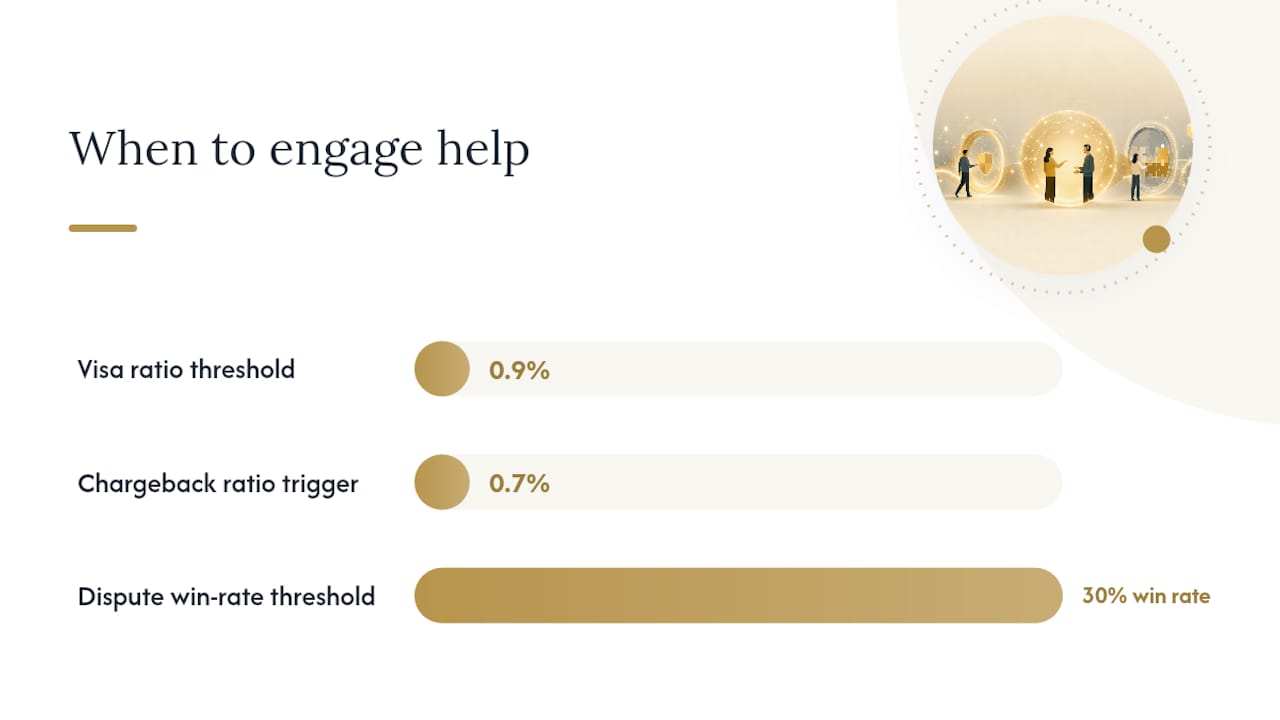
Why thresholds matter: Visa’s network rules flag merchants whose chargeback ratio approaches roughly 0.9%. Breach that level repeatedly and you face higher processing fees, mandatory mitigation programs, or loss of card acceptance entirely. Mastercard’s MATCH list carries similar consequences. Your ratio is not just a metric: it’s a processing license.
How do chargeback types map to prevention tactics?
Not all disputes need the same fix. Treating every chargeback as a fraud problem leads to over-investment in fraud tools while communication failures keep piling up. Stripe’s guidance is clear: match the solution to the cause.
| Chargeback type | Common reason codes | Top 2–3 prevention steps | Operational owner |
|---|---|---|---|
| True criminal fraud | MC 4853 (fraud) | ML scoring, 3D Secure 2.0, velocity checks | Payments / tech |
| Friendly fraud | MC 4853 (not as described) | Clear descriptor, alert networks, proactive comms | CS / payments |
| Merchant error | MC 4834 | Fast refunds, accurate listings, shipping confirmation | Ops / CS |
The practical implication: if your dispute mix skews toward Visa 13.x codes, you have a communication and fulfillment problem, not a fraud problem. Buying a sophisticated ML scoring tool won’t move that number.
Operational and UX changes that prevent chargebacks now
The single most impactful operational changes are the ones that stop customers from reaching for their phone to call the bank. Bank of America’s merchant guidance and PayPal’s prevention framework converge on the same priorities.
Critical (implement within 30 days):
- Fix the billing descriptor. Your statement descriptor should show your brand name or website URL, not your LLC name. Bad: “ACME HOLDINGS LLC.” Good: “YourBrandName.com 800-555-0100.”
- Send a post-purchase sequence. Order confirmation within minutes, shipping notification with tracking, and a delivery confirmation email. Each touchpoint is a dispute you won’t receive.
- Make your refund and cancellation policy impossible to miss. Put it on the checkout page, the confirmation email, and the product page. A customer who can find your return policy doesn’t need to file a dispute.
High priority (30–90 days):
- Enable AVS and CVV verification on all card-not-present transactions and set clear decline rules for mismatches.
- Audit subscription billing flows. Send a reminder email before each recurring charge, confirm the amount, and include a one-click cancellation link. Subscription chargebacks are among the most avoidable.
- Train customer service to offer refunds proactively when a complaint signals dispute risk: a delayed shipment, a damaged product, a billing confusion. Issuing a refund is almost always cheaper than losing a chargeback.
Medium priority (90–180 days):
- Implement delivery confirmation for high-value orders. Signed proof of delivery or carrier-confirmed delivery removes the “item not received” argument entirely.
- Audit product descriptions and images for accuracy. A customer who receives exactly what was described has no grounds for “not as described.”
Pro Tip: For subscription businesses, add the charge amount and next billing date to every renewal reminder. Customers who see the exact dollar amount before it posts rarely dispute it.
The refund-vs-fight calculus is clear: if the order value is below your average chargeback fee plus the ratio damage, refund immediately and document it. Reserve representment for higher-value disputes where you have strong evidence.
What technical controls does your payment stack need?
The non-negotiable technical layer covers five controls. Stripe’s prevention tool overview confirms that no single tool covers every scenario: the right mix depends on your dispute mix and transaction volume.
The five baseline controls:
- AVS (Address Verification Service): Matches billing address to card records. Catches a meaningful share of card-not-present fraud.
- CVV/CVC verification: Confirms physical card possession. Decline transactions where CVV fails.
- Velocity checks: Flag accounts placing multiple orders in a short window, shipping to multiple addresses, or cycling through payment methods.
- 3D Secure 2.0 (3DS2): Shifts fraud liability to the issuing bank on authenticated transactions. Particularly valuable for high-ticket items and subscription renewals.
- ML-based fraud scoring: Real-time risk scoring using device fingerprinting, behavioral signals, and network data. Tools like Stripe Radar apply this automatically; dedicated platforms offer more configurability at higher volume.
When to use integrated provider tools vs. a dedicated platform:
- Low volume (under ~1,000 transactions/month): Your payment processor’s built-in tools (Stripe Radar, PayPal’s fraud filters) are usually sufficient and require no additional integration.
- Mid-volume with mixed dispute types: Add an alert network integration (Ethoca or Verifi) alongside your processor’s native tools.
- High volume or near-threshold ratios: A dedicated fraud platform with configurable ML models, reason-code reporting, and dispute automation earns its cost quickly.
The feature checklist when evaluating any tool: real-time scoring with explainable outputs, false-decline management (a tool that blocks too many good orders is its own revenue problem), event logs exportable for representment evidence, and native integrations with your alert networks.
How do alert networks and chargeback guarantees actually work?
Alert networks and guarantee programs are often confused, but they solve different problems. DirectPayNet’s merchant guide explains the distinction clearly: alert services give you early notice so you can stop a dispute before it posts; guarantee programs shift liability but come with their own tradeoffs.
Alert networks (Ethoca by Mastercard, Verifi by Visa):
- When a cardholder contacts their bank, the alert network notifies you: typically within hours: before the formal dispute is filed.
- You can then issue a voluntary refund, and the chargeback never posts to your ratio.
- The alert fee is typically less than a chargeback fee plus the ratio damage it would cause.
- Coverage is limited to participating issuing banks, so alerts don’t intercept every dispute.
Chargeback guarantee programs:
- A third-party provider (or your processor) absorbs the financial loss on approved transactions that chargeback.
- The tradeoff: the provider’s fraud model may decline more orders than your own, increasing false declines and lost revenue.
- Guarantees typically exclude friendly fraud and merchant error: the two most common dispute types.
Must-have features when evaluating alert or management vendors:
- Integration with both Ethoca and Verifi networks (not just one)
- Configurable response rules (auto-refund vs. manual review thresholds)
- Reason-code reporting and dispute-mix analytics
- Representment support or automation for disputes that aren’t intercepted
- Clear SLA on alert response windows (you typically have 24–72 hours to act)
Chargeback Gurus offers managed dispute services that combine alert network enrollment with representment support: worth evaluating when your team lacks bandwidth for manual dispute handling.
What to do the moment a chargeback arrives
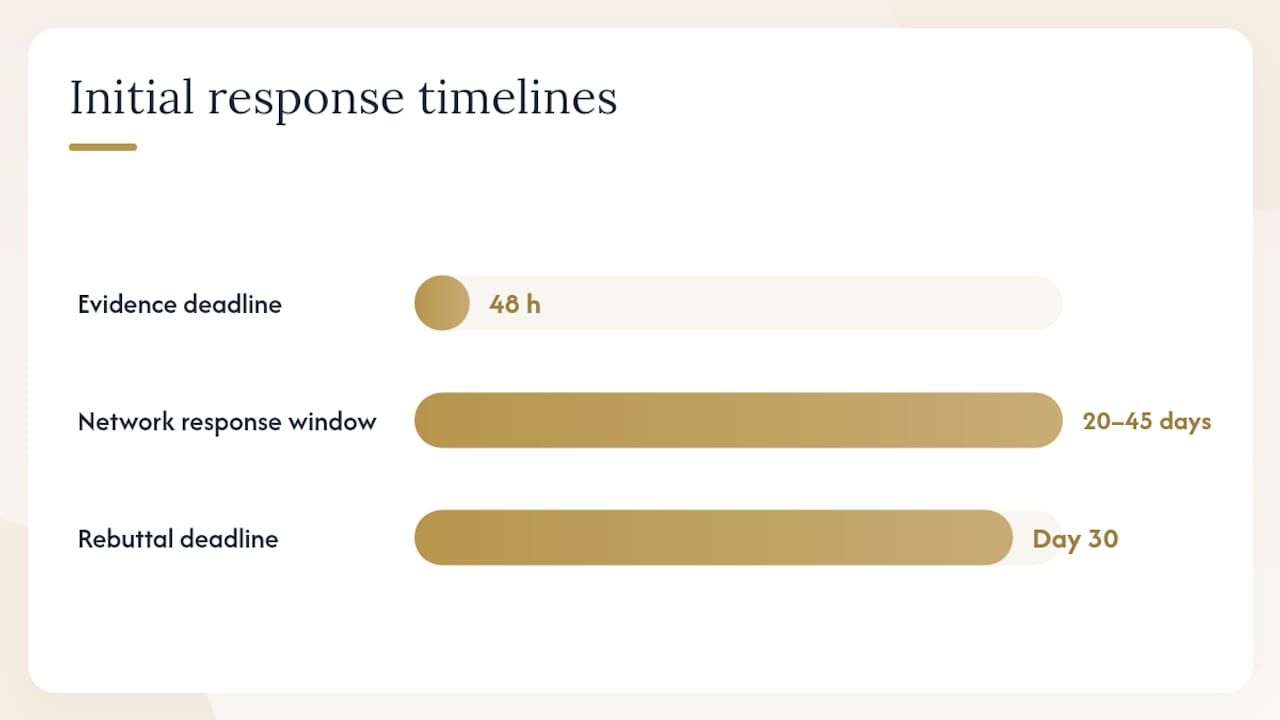
Speed matters. Card networks impose strict response windows: typically 20–45 days depending on the network and reason code: and missing them forfeits your right to dispute.
Representment workflow:
- Triage immediately. Identify the reason code, the transaction amount, and whether you have evidence to win. If the order value is below your average dispute cost, issue a refund and close it.
- Gather evidence within 48 hours. Don’t wait until day 30.
- Submit a rebuttal letter that maps your evidence directly to the reason code’s requirements. Generic responses lose.
- Track outcomes by reason code to identify patterns.
Evidence checklist for representment:
| Evidence type | Applies to |
|---|---|
| Order confirmation with timestamp | All dispute types |
| Shipping carrier tracking + delivery confirmation | Item not received |
| Signed proof of delivery (for high-value orders) | Item not received |
| IP/device log showing cardholder’s location at purchase | Fraud claims |
| Prior successful transaction history (for CE 3.0) | Visa fraud disputes |
| Subscription consent record + cancellation policy | Recurring billing |
| Customer communications (emails, chat logs) | Not as described, friendly fraud |
| Refund record (if already issued) | All types: prevents double loss |
Visa’s Compelling Evidence 3.0 framework is worth understanding specifically: it lets merchants submit prior successful-authentication data to challenge the underlying fraud report in Visa’s VAMP calculations, not just the individual dispute. For merchants with recurring customers, this is a meaningful tool.
Decision rule: Fight when you have delivery confirmation, device logs, or prior transaction history that directly contradicts the claim. Refund when evidence is thin, the amount is low, or the customer has a legitimate grievance you missed.
How to measure chargebacks and match solutions to your dispute mix
The metrics that matter: chargeback ratio (disputes divided by total transactions in the same calendar month), dispute mix by reason code, win rate on representment, and average cost per dispute.
Average cost per chargeback typically includes the chargeback fee ($15–$100 depending on your processor and history), the lost merchandise or service cost, and the processing overhead of responding. When you add ratio damage: the compounding risk of approaching network thresholds: the true cost of each dispute is materially higher than the fee alone.
A simple ROI frame: if a chargeback alert service costs $30 per alert and your average dispute costs $85 in fees plus merchandise, the alert pays for itself on every dispute it prevents. The math shifts when alert coverage is low or your dispute mix is dominated by merchant error that alerts can’t intercept.
Reason-code grouping for diagnosis:
- Group all Visa 10.x and Mastercard 4853 fraud codes together: these signal true fraud and require technical controls.
- Group Visa 13.x codes (item not received, not as described, credit not processed): these signal merchant error and communication failures.
- Codes that don’t fit cleanly into either bucket often indicate friendly fraud, where alert networks and subscription flow improvements are the primary lever.
IntegralPay’s step-by-step guide recommends monthly monitoring as a minimum cadence.
When should you bring in outside help?
Hire external expertise when your ratio approaches Visa’s 0.9% threshold, when root causes are mixed across fraud, friendly fraud, and merchant error simultaneously, or when your team lacks the bandwidth to implement alert network integrations and representment workflows in parallel.
Triggers that justify a diagnostic engagement:
- Chargeback ratio above 0.7% and not declining month-over-month
- VAMP or MATCH exposure (or a processor warning letter)
- Recurring reason codes that haven’t responded to internal fixes
- No structured reason-code reporting in place
- Alert network enrollment still pending after 60+ days
- Dispute win rate below 30%
A formal chargeback reduction plan: the kind processors request when thresholds are breached: should document your dispute sources, current defenses, and a measurable remediation timeline. Building that document without a clear view of your dispute mix is guesswork.
Pro Tip: Before engaging any outside vendor or consultant, pull 90 days of reason-code data and group it into the three buckets above. That single exercise tells you whether you have a fraud problem, a communication problem, or an operations problem: and prevents you from buying the wrong solution.
What a diagnostic engagement delivers: a prioritized remediation plan with 30/90/180-day milestones, identification of the specific reason codes driving ratio damage, and a clear ROI case for each recommended tool or process change. The goal is measurable ratio reduction, not a longer vendor list.
How employee training shapes your chargeback rate
Your customer service team is your first line of dispute prevention, and most merchants underinvest in training them for it. PayPal’s guidance explicitly includes staff training as a primary prevention tactic: not an afterthought.
Train CS representatives to recognize the signals of an impending dispute: a customer asking where their order is after the expected delivery window, a complaint about an unrecognized charge, or a request to cancel a subscription they claim they never authorized. Each of these is a dispute that hasn’t posted yet. A representative supported to issue an immediate refund or resend a shipment resolves the situation in minutes; a representative who escalates to a supervisor or asks the customer to “wait and see” often sends them straight to their bank.
Document every customer interaction that involves a complaint, a refund request, or a shipping issue. Those records become representment evidence if the dispute posts anyway. The connection between clean bookkeeping and dispute defense is direct: bookkeeping practices that maintain clear transaction records make evidence collection a 10-minute task rather than a two-day scramble.
How chargeback management integrates with your processor and merchant account
Your payment processor is not a passive pipe: it’s an active participant in your chargeback ratio and your ability to fight disputes. Most processors offer native dispute dashboards, reason-code reporting, and some form of alert network integration. The question is whether those native tools are sufficient for your volume and dispute mix.
Stripe’s dispute management interface, for example, provides reason-code data, evidence submission workflows, and outcome tracking. For merchants under roughly 500 disputes per month, this is often enough. Above that threshold, or when dispute types are mixed and require different response strategies, a dedicated chargeback management platform layered on top of your processor adds meaningful value through automation and analytics.
The integration point that most merchants miss: ensure your chargeback management tool has read access to your order management system and your shipping carrier data. Without that connection, evidence gathering is manual and slow. The platforms that integrate directly with Shopify, WooCommerce, or your 3PL pull delivery confirmations and order records automatically, cutting response time from days to hours.
Legal and regulatory considerations you need to understand
Chargebacks are governed by federal law (the Fair Credit Billing Act for credit cards, Regulation E for debit), card network rules, and your merchant agreement. The FCBA gives cardholders 60 days from statement date to dispute a charge; Regulation E gives debit cardholders 60 days from statement as well, with different liability rules depending on how quickly they report.
Card network rules layer on top of federal law and are more granular. Visa and Mastercard each publish operating regulations that define reason codes, evidence requirements, and response windows. These rules change periodically: Visa’s Compelling Evidence 3.0 update is a recent example: and staying current matters because an outdated representment strategy can cost you winnable disputes.
Your merchant agreement with your acquirer defines the consequences of exceeding ratio thresholds: reserve requirements, higher interchange, or termination. Read it. Merchants who don’t know their contractual thresholds often discover them only after receiving a warning letter, at which point remediation timelines are compressed.
This article provides general information about chargeback processes and is not legal or financial advice. Confirm current card network rules and your specific merchant agreement terms with your acquirer or a qualified advisor.
The true cost of chargebacks goes deeper than the fee
The visible cost of a chargeback is the dispute fee. The invisible costs are larger. Lost merchandise on fulfilled orders that chargeback. The labor cost of gathering evidence and submitting representment. The opportunity cost of your payments team’s time. And the compounding ratio damage that, once it approaches network thresholds, triggers reserve requirements that tie up working capital.
Understanding profitability best practices for scaling brands means accounting for chargebacks as a margin line item, not just a payment ops problem. That’s the kind of calculation that belongs in your unit economics model, not just your dispute dashboard.
The MATCH list (formerly TMF) is the worst-case outcome: once a merchant is listed, finding a new acquirer becomes extremely difficult. Avoiding it requires staying well below ratio thresholds and maintaining clean processing history: which is exactly why early intervention matters more than late remediation.
Building a continuous improvement plan that actually holds
A chargeback reduction plan is not a one-time project. It’s a monitoring cadence, a root-cause discipline, and a feedback loop between your dispute data and your operations team. ChargebackGurus’ guidance notes that processors commonly request a formal plan when thresholds are breached: but the merchants who never breach thresholds are the ones who built the plan before they needed it.
The structure is clear: document your current dispute mix by reason code, identify the top three root causes, assign ownership and a 30-day action for each, and set a monthly review cadence. Each month, compare your ratio and win rate against the prior period. When a reason code spikes, trace it back to an operational change: a new product launch, a fulfillment partner switch, a subscription price increase: and address the root cause rather than just the symptom.
Merchant Insiders’ practical guide reinforces that fast, clear post-purchase communications stop a disproportionate share of disputes. Build that feedback into your plan: track which email touchpoints correlate with lower dispute rates and protect them from “simplification” during marketing rebrands.
The tradeoff most merchants get wrong
Fraud prevention and conversion are in tension, and most merchants resolve that tension badly: either by ignoring fraud controls until a crisis forces action, or by tightening controls so aggressively that false declines start costing more than the chargebacks they prevent.
The right frame is cost-per-outcome. Every prevention measure has a cost: the alert fee, the false-decline rate, the CS labor, the integration overhead. Every chargeback has a cost too. The goal is not zero chargebacks: it’s a ratio that stays below network thresholds while your prevention spend stays below the cost of the disputes it prevents. Start with the changes that cost less than an average chargeback to implement: descriptor updates, email sequences, refund policy visibility. These are nearly free and often move the ratio more than any paid tool. Reserve the heavier investments for after you’ve exhausted the communication fixes and can see clearly what’s left.
What a Commerce Catalyst diagnostic delivers for merchants facing chargeback pressure
Chargeback problems are almost always a symptom of something deeper: a fulfillment gap, a subscription flow that wasn’t designed for retention, or a fraud exposure that grew faster than the prevention stack. Commerce Catalyst’s DTC Financial Health Assessment identifies those root causes directly, rather than layering tools on top of undiagnosed problems.

An engagement starts with a structured review of your dispute mix, reason-code data, and current prevention stack. From that baseline, you get a prioritized 30/90/180-day remediation plan: specific actions, ownership assignments, and measurable ratio targets. For merchants whose chargeback exposure is materially affecting cash flow or processing access, the fractional CFO engagement provides ongoing implementation support through the full remediation cycle. If you’re ready to stop treating chargebacks as a cost of doing business, the assessment is the right starting point.
Sources
- Visa
- Three types of chargebacks and how to prevent them | Stripe
- Chargeback prevention tools | Stripe
- Ways to reduce chargebacks | Bank of America
- How to reduce chargebacks | PayPal
- Chargeback prevention: The complete merchant’s guide | DirectPayNet