A cash flow waterfall is a prioritized operating model that routes every dollar of incoming cash to the most critical needs first: payroll, production, and reserves, before anything else gets funded. The practical way to run one is a weekly 13-week forecast reviewed every Monday. If you haven’t run that check this week, start there before you read another word.
TL;DR:
- Most brands need a cash flow waterfall to prioritize critical expenses and avoid running out of cash despite showing profit on paper.
- The cycle’s accuracy depends on a detailed 13-week forecast that tracks operating cash flow, deductions, and co-pack cash events weekly.
- Quickly improving cash flow can be achieved by renegotiating supplier terms, tightening deduction disputes, and batching discretionary expenses.
- A governance system with a dashboard, clear ownership, and pre-defined decision rules ensures the waterfall remains effective over time.
- Founders often overlook channel-specific cash timing and inventory delays, which can quickly deplete cash if not modeled correctly.
Table of Contents
- Why a Cash Flow Waterfall Matters for Your Cash Conversion Cycle
- How Do You Build a Cash Flow Waterfall?
- What Powers the Waterfall: The 13-Week Operating Forecast
- Tactics That Free Up Cash This Month
- Building the Governance That Makes It Stick
- What Founders Get Wrong About Managing Their Own Cash
- Get Hands-On Help Building Your Waterfall
- Sources
Why a Cash Flow Waterfall Matters for Your Cash Conversion Cycle
Most founders confuse profitability with liquidity, and that confusion gets expensive fast. Your P&L can show a healthy margin in the same month your bank balance hits zero, because working capital and cash flow measure entirely different things. Working capital tells you what’s tied up in inventory and receivables. Cash flow tells you what’s actually available to spend this week.
The gap between those two shows up in the cash conversion cycle, and it varies enormously by channel. A DTC-only brand often converts cash in 2 to 3 days: customer pays, you ship, done. Sell into specialty retail and that stretches to 120 to 180 days. Mass retail pushes it to 180 to 270 days once you stack manufacturer payment terms, inventory lead time, and retailer terms on top of each other.
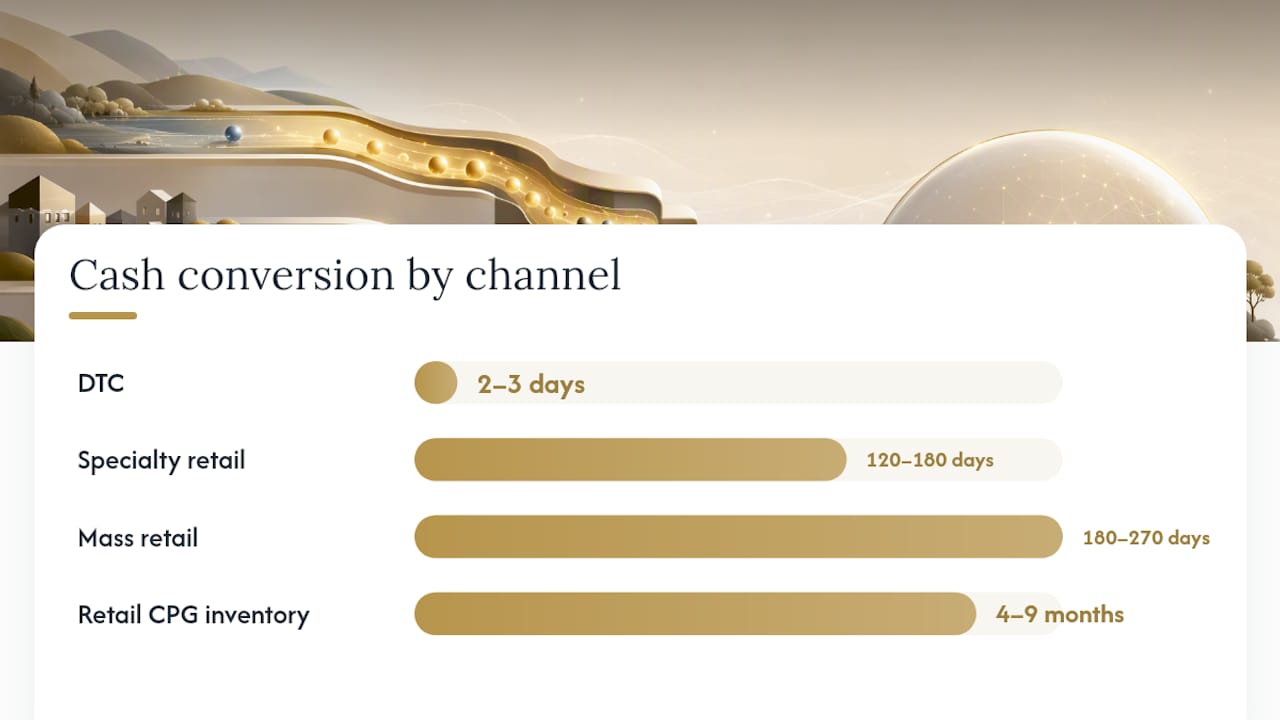
A CPG brand selling into retail can have 4 to 9 months of forward COGS tied up before that inventory converts back to cash.
Here’s where founders get caught: you pay your co-packer on delivery or on 30-day terms, but the retailer pays you on Net 60 or Net 90. That gap is not a rounding error. It’s a financed order, and you’re the one financing it, whether you planned to or not. A cash conversion cycle model that quantifies this gap is the first input your waterfall needs.
That mismatch compounds with every retail door you add. Growth without a waterfall is just a faster way to run out of cash.
How Do You Build a Cash Flow Waterfall?
A waterfall works because it forces order onto a decision founders otherwise make emotionally, under pressure, with the wrong information in front of them. The buckets, in priority order:
- Opening cash on hand. The starting number your entire forecast is built against.
- Minimum cash reserve. A floor you don’t touch, sized to your risk tolerance and payment terms.
- Payroll and critical operating expenses. Rent, insurance, and anything that keeps the business legally and physically running.
- COGS and production deposits. Co-pack deposits, raw materials, and freight tied to confirmed orders.
- Trade spend and marketing, guardrailed. Funded only after the tiers above are covered, and cut first when cash tightens.
- Debt service. Scheduled payments on any line, loan, or financing facility.
- Discretionary spend and owner distributions. What’s left after everything above is cleared.
The buckets only work if you attach real rules to them, not just labels. Hold 4 to 8 weeks of payroll as an untouchable floor. Cap trade spend as a fixed percentage of net revenue rather than a fixed dollar figure, so it flexes down automatically when sales slow.
Your channel mix changes how this reads in practice. A DTC-heavy brand can run a tighter cash floor because collections happen in days, not months. A wholesale-heavy brand needs a deeper reserve because Net 60 and Net 90 terms leave far more cash exposed at any given moment. Early-stage brands should weight the waterfall toward reserves and payroll protection; brands past $10M in revenue can usually afford a slightly more aggressive trade-spend tier because they have more forecasting history to trust.
Pro Tip: Run your waterfall against a “what if this PO ships two weeks late” scenario before you approve any new production run. If that delay pushes your minimum cash floor below zero, you don’t have a scheduling problem. You have a funding problem you haven’t named yet.
What Powers the Waterfall: The 13-Week Operating Forecast
The waterfall is only as good as the forecast feeding it, and a static monthly cash report can’t keep up with a brand juggling retail terms, promotions, and production runs. A 13-week weekly cash forecast that separates the operating cash cycle from trade-promotion math gives you a short enough horizon to act on what you see, every single week.
Two sub-models drive it. The first tracks the operating cash cycle: days sales outstanding, inventory events, and accounts receivable timing. The second is a standalone trade-promotion and deductions ledger, because deduction lags and leakage stay invisible unless you separate them from the general AR roll.
Co-pack runs deserve their own treatment inside the model. Every run generates three separate cash events: the deposit (often 20 to 30% for repeat runs, 30 to 50% for new or custom formulations), the balance payment, and inbound freight. Collapse those into a single “inventory” line and you’ll misjudge exactly which week your cash gets tight.
| Forecast component | What it tracks | Why it matters |
|---|---|---|
| Operating cash cycle | DSO, inventory timing, AR | Shows when cash actually lands, not when a sale books |
| Trade/deductions ledger | Promotions, chargebacks, lag | Surfaces leakage before it eats a quarter’s margin |
| Co-pack cash events | Deposit, balance, freight | Prevents one production run from masking three separate cash hits |
Every Monday, the CFO, head of sales, and head of supply chain sit down for a structured 45-minute review built to produce decisions, not just updates: extend or kill a promotion, reschedule a co-pack run, dispute a large deduction, adjust a DSO assumption that’s drifted from reality.
Tactics That Free Up Cash This Month
You don’t need a financing round to fix a tight waterfall. Most founders have more levers available than they realize, sitting untouched because nobody assigned an owner to pull them.
- Renegotiate supplier terms; even shifting from Net 30 to Net 45 on a major input changes your entire cash position.
- Compress lead times on your highest-volume SKUs so cash isn’t parked in transit for weeks.
- Improve inventory turns on slow movers instead of letting working capital sit on a shelf.
- Tighten deduction matching so retailer chargebacks get disputed within days, not discovered a quarter later.
- Batch discretionary payments into a single weekly run instead of paying vendors the moment an invoice lands.
If operational tactics aren’t enough, financing fills the gap, but the tradeoffs differ sharply by product. Revenue-based financing and purchase-order financing typically cost 6% to 20%+ APR depending on your revenue history and risk profile. A bank line is usually the cheapest option if you qualify, but qualification takes time you may not have. Invoice factoring and purchase-order financing get cash faster, at a real cost, and they work best as a bridge, not a permanent fixture in your capital structure.
Pro Tip: Set a minimum cash threshold, usually 4 to 8 weeks of operating expenses, and write down in advance what happens if you breach it: which spend gets cut first, who approves an exception, and how fast you escalate. Deciding the rule on a calm Tuesday beats deciding it in a panic on a Thursday.
Run your forecast under three scenarios, aggressive, base, and conservative, so a bad week doesn’t force a decision you haven’t already thought through.
Building the Governance That Makes It Stick
A waterfall without governance decays into a spreadsheet nobody opens after the second week. The fix is a small, specific dashboard and a named owner for each part of it.
Track these fields weekly, no more and no less:
- Opening cash balance for the week
- Net cash position, week by week, across the full 13-week window
- Upcoming production deposits and balance payments
- Unmatched or disputed retailer deductions
- The single biggest cash risk on the horizon
Assign clear ownership. One person updates the forecast every Friday. The Monday review has a fixed attendee list, typically finance, sales, and supply chain. Someone specific executes whatever decision comes out of that meeting, not “the team.”
Decision rules should be written down before you need them: if projected cash falls below your floor in any forecasted week, marketing spend gets capped automatically, and any exception requires sign-off above the person who set the budget. Rules made in advance remove the guesswork exactly when guesswork is most dangerous.
What Founders Get Wrong About Managing Their Own Cash
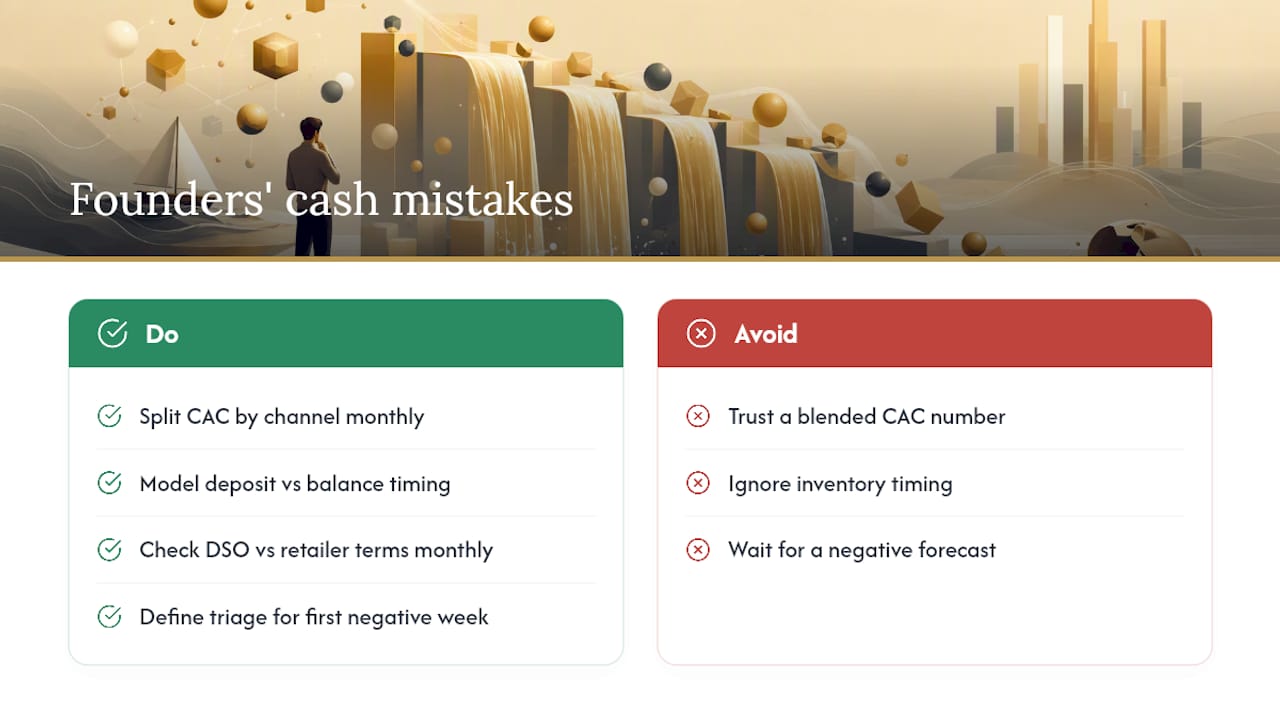
Inventory timing is the other silent killer. A production run that ships two weeks late doesn’t just delay revenue, it can collapse your entire 13-week runway if you haven’t modeled the deposit and balance as separate events.
Two shortcuts are worth adopting immediately: check your DSO against your stated retailer terms monthly (drift here is an early warning sign, not noise), and build a triage rule now for what happens the first week your forecast goes negative. Waiting until it happens is how good operators make bad decisions.
Get Hands-On Help Building Your Waterfall
There are other ways to get here: a spreadsheet template, a part-time bookkeeper, a generic FP&A consultant. None of them are built specifically for the working capital pressures a consumer brand faces between production deposits and retailer terms. Some consulting services specialize in that gap, translating specific cash-timing problems into a prioritized model you can defend to a board or a lender, not a generic framework retrofitted to your business.

If you’re not sure where your waterfall breaks first, start with the DTC Financial Health Assessment to pinpoint the actual constraint before you spend another dollar guessing. Founders who already know the problem and need it fixed fast often move straight into the 90-Day Profit Sprint. If you need someone embedded in the weekly cadence long term, the Fractional COO engagement builds that governance directly into your operating rhythm. Book a diagnostic call and bring this week’s cash number with you.
Sources
- A 13-week cash flow forecast template for CPG brands in trade cycles.: Putra & Co
- The Modern Cash Flow Blueprint for CPG Brands - Foodbevy