Most ecommerce brands pay $3.50 to $8.00 per order for fulfillment-only work in 2026, and $8 to $15 per order once shipping and accessorial fees get added. Pallet storage runs a median of about $20.17 per month, receiving averages roughly $10.52 per pallet, and monthly minimums now sit near $517. None of those numbers matter as much as one variable: your order profile, meaning how many items go into a typical box. A brand shipping 1,000 single-item orders a month pays meaningfully less than a brand shipping 1,000 multi-item orders, even at identical volume.
Here’s the piece that trips up most founders comparing quotes: shipping and postage is usually the largest line on the invoice, often 60% to 70% of total spend. A “cheap” pick-and-pack rate can hide a mediocre postage markup that erases the savings.
The headline ranges, before you dig into your own numbers:
- Fulfillment-only per order: $3.50 to $8.00
- All-in per order (shipping included): $8 to $15
- Pallet storage: roughly $18 to $25 per month, median $20.17
- Receiving: roughly $5 to $15 per pallet
- Monthly minimum: averaging $517
Pro Tip: Don’t trust a quote until you’ve run one real month of your own order data through it. A rate sheet tells you the price of each line item. A worked month tells you what you’ll actually pay.
Key Takeaways
Order profile and shipping structure, not the headline per-order fee, determine whether a 3PL quote is actually competitive once every line item is modeled.
| Point | Details |
|---|---|
| Know your true range | Fulfillment-only runs $3.50 to $8.00 per order; all-in with shipping runs $8 to $15. |
| Shipping dominates the invoice | Postage often represents 60% to 70% of total 3PL spend, more than any other line. |
| Order profile beats volume | Items per order changes your blended pick rate more than raw monthly order count. |
| Model, don’t estimate | Run a full worked month through the cost-per-order formula before comparing quotes. |
| Watch minimums and accessorials | Monthly minimums average $517, and container unloads can run $250 to $500 flat. |
| Get a cash-flow model, not just a rate card | Commerce Catalyst’s Financial Health Assessment ranks 3PL fee changes by real dollar impact on cash flow. |
Table of Contents
- What Are the Standard 3PL Cost Benchmarks?
- Why Do 3PL Fees Vary So Much Between Providers?
- Which 3PL Pricing Model Fits Your Order Profile?
- How Do You Calculate Your True Cost Per Order?
- What Hidden Fees Should You Watch For Before Signing?
- What Should You Bring to a 3PL Negotiation?
- How Should You Prioritize 3PL Cost Changes for Cash Flow?
- Sources
What Are the Standard 3PL Cost Benchmarks?
Comparing quotes gets easier once you know what the market actually charges for each line item. The table below pulls from published rate-card audits and a dataset of 98 anonymized RFP quotes collected between July 2023 and December 2024, giving you a reasonable floor and ceiling for nearly every fee a 3PL will put in front of you.
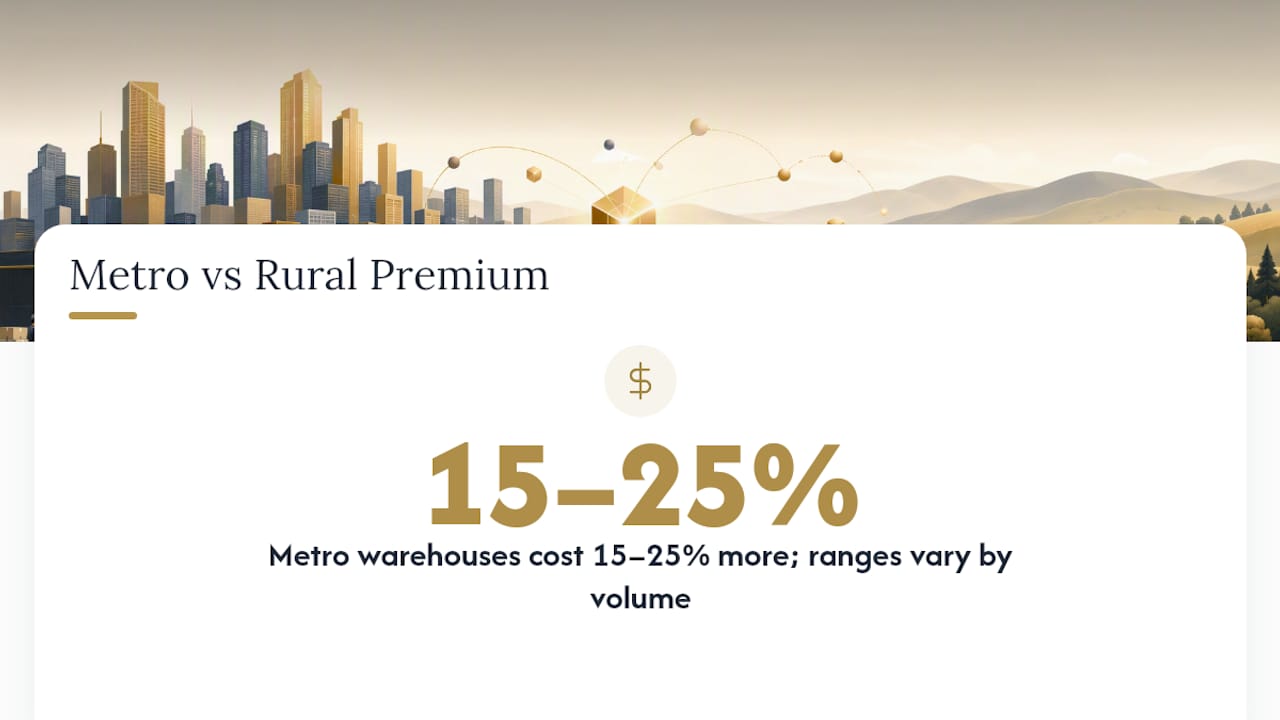
Two things distort these ranges more than anything else. First, metro-area warehouses (think greater New York, Los Angeles, or Chicago) routinely run 15% to 25% above rural or secondary-market facilities, because labor and real estate cost more there too. Second, the spread inside each row is wide because volume bands change everything: a brand doing 500 orders a month and a brand doing 25,000 orders a month are effectively buying different products, even from the same 3PL.
Why Do 3PL Fees Vary So Much Between Providers?
Every fee on that rate card exists for a reason, and understanding the mechanics behind each one is what lets you spot a bad deal before you sign a contract.
Receiving gets billed three ways: per pallet, per hour, or as a flat container fee. Per-pallet pricing is predictable if your inbound shipments arrive palletized and labeled correctly. Costs spike fast when a container arrives floor-loaded (loose boxes stacked with no pallets), because the 3PL has to pay labor to sort and palletize it manually, often at $35 to $50 an hour.

Storage billing methods matter more than the headline rate. Some 3PLs bill by the pallet position, some by the bin, some by cubic foot occupied. Ask whether storage is billed on your peak inventory during the month or your average daily balance. Peak billing can quietly double your storage cost during a big inventory receipt, even if you sold most of it down within a week. Watch for long-term storage surcharges too. Roughly half of warehouses charge them on inventory sitting past 90 days.
Pick and pack pricing structures almost always follow a “first item plus extra unit” model. The first item in an order costs more because it includes the labor of locating the order, walking to the bin, and starting the pack. Every additional item in that same order costs less because the labor is already in motion. This is exactly why order profile matters so much: a brand averaging 2.5 items per order pays a blended rate lower than the headline “per order” number suggests, while a single-item brand pays closer to the sticker price.

Packaging costs get marked up more than any other line, because it is the easiest place to bury margin. A 3PL might quote a low pick fee, then charge $1.20 for a $0.40 mailer. Ask for a materials cost breakdown, not just a bundled per-order packaging fee.
Shipping is billed either as a pass-through (the 3PL charges you the exact carrier rate, sometimes with a small handling fee) or as cost-plus (a markup on the carrier rate, often undisclosed). Since postage represents the majority of total invoice cost for most DTC brands, request zone and weight-tier detail in writing before you sign.
Returns processing typically runs $2 to $5 per return and often includes inspection and restock. Confirm whether damaged or unsellable returns get a separate disposal fee.
Integration and account fees for WMS access, EDI setup, or API connections range from a few hundred dollars one-time to ongoing monthly charges near $100. Amortize one-time technology fees across a realistic contract length (12 to 24 months) rather than treating them as sunk costs in your first-month math, and negotiate a waiver if you’re bringing meaningful volume.
Which 3PL Pricing Model Fits Your Order Profile?
Providers generally sell one of three pricing structures, and the one that looks cheapest on paper is not always the one that’s cheapest for your specific order profile.
-
Itemized per-line pricing. Every fee, receiving, storage, pick, pack, postage, gets billed separately. This model is the most transparent because you see the true cost of labor and space. It rewards brands that can improve their own order profile (fewer SKUs, palletized inbound) since savings show up directly.
-
Bundled per-order pricing. The 3PL quotes one flat number per order that covers pick, pack, and materials, sometimes with storage rolled in. This is easier to budget with, but a flat bundled rate can mask a postage or storage markup you can’t see. It tends to suit brands with a consistent, simple order profile: mostly single-item orders, low SKU count, minimal seasonality.
-
Subscription or managed-service pricing. A flat monthly fee, sometimes tiered by volume, that covers most operational line items. This model suits brands that want budget certainty over granular cost control, and it often works best for smaller, high-consistency catalogs where variability is low.
A low headline per-order number under a bundled model is worth investigating specifically because the savings often reappear elsewhere as inflated storage or postage. Always ask for the itemized breakdown behind any bundled quote before comparing it to a competitor’s line-item rate sheet.
How Do You Calculate Your True Cost Per Order?
Vendor quotes rarely tell you what you’ll actually pay each month. Getting a real number requires running your own order data through a simple formula:
All-in cost per order = (amortized one-time fees + recurring fees + handling costs + shipping + returns) ÷ orders shipped in the period
Here’s how that plays out for a mid-size DTC brand shipping 3,000 orders a month, averaging 1.8 items per order:
- Amortize setup costs. A $2,400 onboarding fee spread across 24 months adds $100/month, or $0.03 per order at this volume.
- Add recurring fixed costs. A $517 monthly minimum plus a $103 tech fee totals $620/month, or roughly $0.21 per order.
- Calculate handling. At $1.50 for the first item and $0.35 per extra unit, 3,000 orders averaging 1.8 items costs about $5,340, or $1.78 per order.
- Add shipping. At a median parcel postage of $6.55, shipping alone runs $19,650, or $6.55 per order.
- Add returns. Assuming an 8% return rate at $3.50 per return, that’s 240 returns costing $840, or $0.28 per order.
That $8.85 all-in figure lands squarely inside the $8 to $15 all-in benchmark range cited across industry analysis, and it’s the number you should be comparing against competing quotes, not the headline “$1.50 per order” pick fee a sales rep leads with. Run the same formula with a higher items-per-order average or a different shipping zone mix, and the total shifts fast. That sensitivity is exactly why order profile matters more than raw volume when two brands compare notes on 3PL pricing.
What Hidden Fees Should You Watch For Before Signing?
The fees that blow up a 3PL budget almost never show up on the headline rate sheet. They show up three months into the contract, buried in an invoice line you didn’t know to ask about.
- Dimensional-weight rebills, where the carrier reclassifies a lightweight but bulky box at a higher shipping tier after the fact.
- Address correction fees, typically $10 to $18 per incident, charged when a customer’s shipping address needs carrier correction.
- Inventory removal or disposal fees, charged when you terminate a contract and need product shipped out or destroyed.
- Peak-season surcharges layered on top of standard rates from roughly October through December, sometimes without advance notice.
- Long-term storage penalties on inventory sitting past a defined age threshold, often 90 days.
- Container unload charges of $250 to $500 flat, or $35 to $50 an hour, triggered when inbound freight arrives floor-loaded instead of palletized.
Contract language deserves the same scrutiny as the rate sheet itself. Confirm exactly when the billing month starts (calendar month versus contract anniversary), whether minimums get retroactively applied if you fall short mid-month, and how a minimum gets calculated for a seasonal business. Get written confirmation of your inbound palletization requirements, since that single detail determines whether you pay $10 a pallet or $400 a container.
Pro Tip: Ask every finalist 3PL for a sample invoice from an existing client with a similar order profile to yours, not just a rate sheet. Rate sheets show intentions. Invoices show reality.
If your business has seasonal swings, insist on quarterly or annualized minimum calculations rather than a strict monthly gate. A monthly minimum that looks fine in November can wreck your February cash flow if volume drops and the 3PL enforces the floor anyway.
What Should You Bring to a 3PL Negotiation?
Rate negotiations go nowhere useful without hard numbers in hand. Before you request quotes, compile this exact data set:
- Orders per month, ideally trailing 12-month average plus peak-month figures.
- Average items per order, since this single number reshapes every pick-and-pack quote you’ll receive.
- Pallet count and cadence of inbound shipments.
- Your top five ship-to zones by order volume, so you can request real postage detail instead of an estimate.
- Whether your inbound freight arrives palletized or floor-loaded.
Once you have that profile assembled, five levers move pricing more than anything else on the table: committing to a volume tier, palletizing inbound freight instead of shipping loose boxes, consolidating SKU count to reduce pick complexity, considering a multi-warehouse strategy to cut shipping zones and postage, and negotiating true carrier pass-through instead of an undisclosed shipping markup.
Requiring a sample invoice from a comparable client, then running that same worked-month formula from the calculation section above across every competing quote, is the only way to compare true monthly cost rather than a cherry-picked line item.
Pro Tip: Never negotiate one fee in isolation. A 3PL that drops your pick fee by $0.20 often recoups it through a slightly worse postage pass-through rate. Negotiate the all-in cost per order, not individual line items.
How Should You Prioritize 3PL Cost Changes for Cash Flow?
Most founders negotiate the fee that annoys them most, usually the pick-and-pack rate, instead of the fee that actually moves their bank balance. That’s backward. A $0.15 reduction on a $1.50 pick fee saves 10%, which sounds significant until you compare it to a 5% reduction on a $6.55 postage line that represents 60% to 70% of your total invoice.
The right way to prioritize: rank every fee delta by its dollar impact on monthly cash burn and contribution margin, not by percentage savings on that single line. A shipping-rate renegotiation almost always outranks a pick-fee renegotiation in raw dollar terms, even when the percentage discount looks smaller on paper.
A useful heuristic for where to spend your negotiating energy:
- Rank fees by total monthly dollar volume first, not by unit price.
- Model any proposed fee change against a full month of real orders before accepting it, since a small per-unit change compounds differently across 500 orders versus 15,000.
- Treat monthly minimums as a fixed cost that hits hardest during slow months, and model your worst month, not your average one.
- Separate fixed 3PL costs (minimums, tech fees, storage) from variable ones (pick, pack, postage) so you know which line moves with volume and which one doesn’t, a distinction that matters just as much when you’re separating fixed and variable costs elsewhere in your business.
This is the exact model behind the Commerce Catalyst Diagnostic: convert a stack of 3PL quotes into a single cash-flow number, then rank the fixes by how much runway or EBITDA impact they actually deliver.
A Founder’s Take on 3PL Cost Mistakes
The better question isn’t “what’s the cheapest quote?” It’s “which fee structure protects contribution margin when volume dips?” Fulfillment costs only matter in relation to what they do to your cash position, not as a standalone percentage. That’s the lens worth applying before signing anything.
How Commerce Catalyst Turns a Rate Sheet Into a Cash-Flow Plan
Reading a 3PL rate card tells you what a provider charges. It doesn’t tell you what a fee change does to your bank balance three months from now, and that gap is where most founders get stuck comparing quotes in isolation.

The DTC Financial Health Assessment takes your actual order data, current 3PL quotes, and cash position, then builds the worked-month model this article walks through, ranked by real dollar impact rather than percentage discounts. If you already know logistics is squeezing margin and need a prioritized plan to fix it fast, the 90-Day Profit Sprint turns that diagnostic into a scoped, hands-on engagement built around the fixes that move cash flow first. Both are paid advisory engagements, not free tools, built for founders running $5M to $75M in revenue who need a real answer before their next 3PL contract renewal. Book a Financial Health Assessment to see exactly where your current fulfillment spend is costing you more than it should.
Sources
- How Much Does a 3PL Cost in 2026? 16 Fee Benchmarks
- 3PL Pricing and Rates Guide (2026): What Fulfillment Should Cost | 3PL Hub
- How much does a 3PL cost?: 3PL Insider research
- FreightWaves: 3PL costs analysis (Checkpoint)
Recommended
- 2026 DTC Benchmarks by Category: CAC, Margins, LTV, Profitability | Commerce Catalyst
- Food & Beverage Brand Benchmarks 2026: CAC, Margins, LTV, Profitability | Commerce Catalyst
- Your Landed Cost Just Changed. Here’s How to Think About It. | Commerce Catalyst
- Supplements & Wellness Brand Benchmarks 2026: CAC, Margins, LTV, Profitability | Commerce Catalyst